
In this article
- A Practical Guide for Bangladeshi Business Owners, Startups, and Growing Companies
- What Is Custom Website Development?
- Why Businesses in Bangladesh Need Professional Website Development
- Types of Custom Website Development Services
- Custom Website Development vs WordPress, Website Builders, and Ready-Made Templates
- Essential Features of a High-Performing Business Website
- The Custom Website Development Process: Step by Step
- Step 1: Define Your Business Goals
- Step 2: Identify Your Target Audience
- Step 3: Prepare a Detailed Requirements Document
- Step 4: Plan the Website Structure
- Step 5: Design the User Experience and Interface
- Step 6: Choose the Technology Stack
- Step 7: Develop the Website
- Step 8: Test Before Launch
- Step 9: Launch and Monitor
- How Much Does Custom Website Development Cost in Bangladesh?
- How Long Does Custom Website Development Take?
- How to Choose the Best Website Development Company in Dhaka
- Common Website Development Mistakes Businesses Should Avoid
- Custom Website Development and Business Growth
- Measuring the Return on Investment of a Business Website
- The Future of Custom Website Development
- Why Consider Creative Tech Park for Custom Website Development in Bangladesh?
- Frequently Asked Questions About Custom Website Development
- What is custom website development?
- How much does custom website development cost in Bangladesh?
- How long does it take to develop a custom website?
- Is custom website development better than WordPress?
- Is custom website development suitable for small businesses?
- Will a custom website rank higher on Google?
- Can I update the website without hiring a developer?
- Who owns the website after development?
- Does a business website need ongoing maintenance?
- What should I prepare before hiring a website development company?
- Final Thoughts: Build a Website Around Your Business Goals
A Practical Guide for Bangladeshi Business Owners, Startups, and Growing Companies
A website should do more than display your company name, list your services, and provide a contact number. For a growing business, it should help attract potential customers, explain what makes the company different, build trust, and turn website visitors into real business opportunities.
Yet many businesses in Bangladesh still struggle with websites that load slowly, look outdated on mobile devices, fail to generate enquiries, or become difficult to manage as the company grows. Others invest in a ready-made website only to discover that it cannot support their actual business processes.
This is where custom website development becomes valuable.
Instead of forcing your business into the limitations of a pre-built design, custom development allows you to build a website around your objectives, customers, workflows, and future plans. Whether you operate a local service company in Dhaka, manage an e-commerce business, launch a startup, or run an established organisation, the right website can become an important part of your long-term business strategy.
Creative Tech Park, a Dhaka-based web design, software development, and IT services agency operating since 2012, works with businesses that need digital solutions aligned with their commercial goals. With a reported team of 26 in-house professionals, more than 5,000 clients, and over 7,000 completed projects, the company brings experience across a broad range of digital requirements.
This guide explains how custom website development works, when it makes sense, what it costs, how to select a development partner, and how to plan a website that delivers lasting business value.
What Is Custom Website Development?
Custom website development is the process of planning, designing, building, testing, and maintaining a website according to the specific requirements of a business or organisation.
Unlike a standard template website, a custom-built solution can include unique page layouts, tailored functionality, specialised integrations, and business-specific workflows. The development team starts by understanding what the organisation needs to achieve and then builds the website around those requirements.
For example, a small consultancy may need a professional website with service pages, enquiry forms, and appointment scheduling. A wholesale distributor may require a customer portal with product catalogues, account-based pricing, and order management. An online retailer may need product filters, payment processing, inventory tracking, and delivery integrations.
All three businesses need websites, but their requirements are different.
Custom development recognises those differences rather than treating every business as if it follows the same process.
How Custom Website Development Differs from Template-Based Websites
A template-based website uses a pre-designed layout that can be modified with a logo, colours, images, text, and selected features. This approach can be effective when the requirements are straightforward.
A custom website, on the other hand, is designed around a more specific set of business requirements. The development team can create tailored interfaces, develop specialised features, and structure the system to support the organisation’s operations.
The main differences include:
- Design flexibility: Custom websites provide greater freedom to match the company’s brand, audience, and user experience requirements.
- Feature development: Specialised functionality can be developed to support the company’s actual workflows.
- Integration options: Custom solutions can connect with suitable accounting systems, inventory platforms, customer relationship management software, and other business tools.
- Scalability: The architecture can be planned around anticipated growth, although future expansion still depends on good technical decisions.
- Ownership and control: Businesses can negotiate access to source code, hosting, documentation, and intellectual property under the development agreement.
- Initial investment: Custom projects generally require more planning, development time, and budget than simple template-based websites.
A template is not automatically a poor choice, and custom development is not automatically the right choice for everyone. The best approach depends on the complexity of the business, the required functionality, the available budget, and the expected return.
Why Businesses in Bangladesh Need Professional Website Development
Bangladesh’s business environment includes traditional retailers, manufacturers, professional service providers, technology startups, exporters, educational institutions, and rapidly growing online businesses.
Customers increasingly use search engines, social media, online directories, and mobile devices to research companies before making purchasing decisions. A professional website gives businesses a place to present reliable information without depending entirely on third-party platforms.
Consider a Dhaka-based industrial supplier. A potential customer may want to check product specifications, compare available services, download a catalogue, and request a quotation before contacting the sales team. If the supplier’s website provides clear information and an easy enquiry process, it can help the company compete more effectively.
The same principle applies to a law firm, property developer, training institute, logistics provider, or software company.
Building Trust with Potential Customers
A professional website creates an opportunity to communicate credibility before a sales conversation begins.
Visitors should be able to understand what the company does, whom it serves, how to make contact, and why they should consider its services.
Important trust-building elements include:
- A clear company introduction and service description.
- Genuine business contact information.
- Relevant project examples and case studies.
- Customer testimonials that can be substantiated.
- Professional photographs and consistent branding.
- Transparent pricing information or a clear quotation process where appropriate.
- Privacy information and appropriate legal notices.
- Secure browsing through HTTPS.
Businesses should avoid publishing invented testimonials, misleading client logos, or unsupported claims about their experience. Trust is easier to establish when website content is specific, accurate, and verifiable.
Reaching Customers Beyond a Physical Location
A business based in Dhaka may want to attract customers throughout Bangladesh or reach international buyers.
A properly structured website can support those objectives through search engine optimisation, relevant service pages, useful content, and clear enquiry options. It can also help an organisation present its products and capabilities to prospective customers who may never visit its physical office.
For example, a manufacturer can publish product specifications and downloadable technical documents. A consulting firm can explain its services through detailed landing pages. An IT company can showcase relevant projects and describe its development process.
These resources give potential customers more reasons to contact the business.
Improving Business Efficiency
Website development can also reduce repetitive administrative work.
Depending on the requirements, a website may allow customers to submit structured enquiries, schedule appointments, register for courses, check order status, or access account information.
For example, a training institute could accept online applications and allow students to view course details before contacting its administration team. A service company could collect customer addresses, service categories, and preferred appointment times through an enquiry form.
The benefit is not simply that the business has a website. It is that the website helps customers and staff complete tasks more efficiently.
Types of Custom Website Development Services
The right website structure depends on the organisation’s industry, customers, and operating model. A business should identify its actual requirements before choosing a development approach.
Corporate Website Development
A corporate website communicates the company’s identity, services, capabilities, and business value.
It commonly includes:
- Home page.
- About the company.
- Services or solutions.
- Industries served.
- Portfolio or case studies.
- News, insights, or resources.
- Careers.
- Contact information.
Corporate website development is suitable for established companies, B2B service providers, manufacturers, consultants, and organisations that need a professional online presence.
The focus should be on clarity, credibility, and generating relevant business enquiries.
E-Commerce Website Development
An e-commerce website enables businesses to sell products online.
Depending on the business model, it may include product catalogues, category pages, search and filtering, shopping carts, customer accounts, payment gateways, inventory management, delivery options, and order tracking.
For a Bangladeshi retailer, the checkout process may need to support locally relevant payment methods and delivery arrangements. Cash on delivery may be appropriate for some businesses, while others may require digital payments or international payment support.
Payment gateway availability, transaction fees, settlement procedures, and regulatory requirements should be confirmed before development begins.
A good online store also needs an efficient product management system. Staff should be able to update prices, descriptions, stock levels, and product images without unnecessary technical work.
Custom Web Application Development
Some businesses need more than a conventional website. They need a browser-based application that supports specialised operations.
Examples include:
- Customer and supplier portals.
- Inventory management systems.
- Employee dashboards.
- Booking and appointment platforms.
- Online learning management systems.
- Project management applications.
- Quotation and order processing systems.
- Membership platforms.
These projects usually require detailed workflow planning, user permissions, database design, testing, and ongoing maintenance.
The key question is whether the proposed application solves a genuine business problem. Developing unnecessary features increases cost and complexity without necessarily improving results.
Landing Page Development
A landing page is designed around a specific marketing objective, such as generating leads, promoting a service, or encouraging registrations.
A strong landing page usually includes a clear headline, a focused value proposition, supporting information, relevant proof, and a visible call to action.
For example, a company promoting website development services in Dhaka might create a dedicated landing page explaining its services, project process, target customers, and quotation procedure.
Landing pages work best when their messaging matches the advertisement, search query, or campaign that brings visitors to the page.
Website Redesign and Modernisation
A business does not always need a completely new system. Sometimes, improving an existing website is the more practical option.
A redesign may address outdated layouts, confusing navigation, poor mobile usability, slow page loading, inaccessible content, weak calls to action, or technical SEO problems.
Before rebuilding a website, the development team should review existing content, rankings, incoming links, analytics, integrations, and important user journeys.
If the business already receives valuable organic traffic, careless URL changes can damage performance. A redesign should therefore include an appropriate content migration and redirect plan.
Custom Website Development vs WordPress, Website Builders, and Ready-Made Templates
One of the most important decisions is choosing the right technology and development approach.
Custom development is not the only way to build a professional website. WordPress, hosted website builders, and other established platforms can be excellent options when their capabilities match the business requirements.
When WordPress Is the Right Choice
WordPress is often suitable for corporate websites, blogs, service websites, content-rich websites, and many small to medium-sized e-commerce projects.
Its advantages include a familiar content management system, a broad ecosystem of themes and plugins, and the ability to publish and update content without coding every change.
A WordPress website can also be customised extensively. However, complex integrations or specialised workflows may require custom plugins, additional development, or a different architecture.
Businesses should pay attention to plugin quality, security updates, hosting performance, compatibility, and maintenance requirements.
When a Website Builder Is Enough
Hosted website builders can be useful for freelancers, small businesses, portfolio websites, and simple service websites.
They often provide visual editing tools, hosting, and basic functionality within one service. This can reduce the technical effort required to launch a website.
However, some builders restrict advanced integrations, data access, custom workflows, or migration options. Businesses should check those limitations before committing to a platform.
When Fully Custom Development Makes Sense
A more tailored development approach becomes attractive when the business needs functionality that standard platforms cannot support efficiently.
This may include complex customer permissions, specialised operational workflows, extensive system integrations, unique data models, or a web application that forms part of the company’s core service.
The decision should be based on requirements rather than the assumption that custom code is always more professional.
A practical rule: Choose the simplest technology that can meet your current requirements reliably while providing a sensible path for future growth.
Essential Features of a High-Performing Business Website
A website should be evaluated by how effectively it serves its users and supports business goals, not simply by how attractive it looks.
Responsive and Mobile-Friendly Design
Many customers in Bangladesh access websites through smartphones. A website that works well on a desktop but becomes difficult to use on a smaller screen can lose potential enquiries.
Responsive web design adapts page layouts to different screen sizes.
Important considerations include:
- Readable text without excessive zooming.
- Navigation that works on mobile devices.
- Buttons with adequate spacing.
- Forms that are easy to complete.
- Images that fit the available screen width.
- Contact details that are easy to find.
- A checkout process that works smoothly on mobile.
The development team should test the website on different screen sizes and browsers rather than relying on a single desktop preview.
Fast Page Loading
Website speed affects usability and can influence conversion rates. Visitors may abandon a page when it takes too long to load, especially when using a slower mobile connection.
Performance improvements can include image compression, modern image formats, caching, efficient code, suitable hosting, and reducing unnecessary third-party scripts.
Google’s Core Web Vitals provide useful measures of real-world loading performance, responsiveness, and visual stability. Developers should monitor these metrics and investigate pages that perform poorly.
A technically impressive website is of limited value if customers struggle to open it.
Search Engine Optimisation
Search engine optimisation helps search engines discover, understand, and present relevant website pages.
Custom website development should account for SEO from the beginning rather than treating it as an optional task after launch.
Important technical and content elements include:
- Descriptive page titles and meta descriptions.
- Logical heading structures.
- Search-friendly URLs.
- XML sitemaps.
- Appropriate robots directives.
- Canonical tags where needed.
- Internal links between related pages.
- Descriptive image alternative text.
- Mobile usability and page speed.
- Structured data when appropriate.
- Proper redirects for changed URLs.
Technical SEO creates a sound foundation, but it does not guarantee high rankings. Useful content, competition, website authority, search intent, and ongoing improvements also matter.
Security and Data Protection
A business website may collect names, email addresses, phone numbers, order details, or other personal information. That data must be handled responsibly.
Security measures should reflect the website’s complexity and risk level.
Common measures include HTTPS, secure authentication, access controls, regular software updates, validated form inputs, reliable backups, and appropriate monitoring.
For websites handling payments or sensitive customer information, the security plan should also address payment provider requirements, data retention, incident response, and applicable legal obligations.
Businesses should avoid storing payment card information unnecessarily and should use reputable payment providers when accepting online payments.
Content Management and Administration
Business owners should not need a developer to change every phone number, update every service description, or publish a new article.
A suitable content management system allows authorised staff to manage routine updates while preserving the website’s design and security.
The administration interface should be appropriate for the people who will use it. Clear menus, documented procedures, and role-based access can reduce mistakes and save time.
Analytics and Conversion Tracking
Website analytics help businesses understand whether their website is achieving its objectives.
Depending on the project, measurement may include:
- Website traffic and traffic sources.
- Service page engagement.
- Contact form submissions.
- Telephone and email enquiries.
- Product purchases.
- Checkout abandonment.
- Appointment bookings.
- Campaign landing page performance.
Google Analytics, Google Search Console, and other suitable tools can provide useful information when configured correctly.
Tracking should respect applicable privacy requirements, and businesses should avoid collecting information they do not need.
The Custom Website Development Process: Step by Step
A successful project begins with clear decisions, not with coding.
Step 1: Define Your Business Goals
Start by identifying what the website must accomplish.
Possible objectives include generating qualified leads, selling products, improving customer support, publishing industry information, or automating internal processes.
Make the objectives specific enough to measure.
For example, instead of saying, “We need a better website,” define the goal as, “We need a website that helps prospective corporate clients understand our services and submit detailed quotation requests.”
This gives the project team a clear direction.
Step 2: Identify Your Target Audience
Understand who will use the website and what they need.
For a B2B company, the audience may include procurement managers, business owners, technical teams, and corporate decision-makers. Each group may require different information before approving a purchase.
Consider the questions visitors are likely to ask:
- What does the company offer?
- Which industries does it serve?
- What problems can it solve?
- How does its process work?
- What evidence supports its claims?
- How can a prospective customer request more information?
Answering these questions helps determine the site’s content and navigation.
Step 3: Prepare a Detailed Requirements Document
Document the required pages, features, user roles, integrations, and administrative needs.
Separate the requirements into three categories:
Essential features: Functions needed for launch, such as service pages, contact forms, or product listings.
Important improvements: Features that provide meaningful value but can be introduced after launch if necessary.
Future enhancements: Ideas that may become useful when the business grows or gathers more user feedback.
This prioritisation prevents a project from becoming unnecessarily complicated.
Step 4: Plan the Website Structure
Create a sitemap that explains how pages relate to one another.
A typical corporate website might include the home page, company information, service pages, industry pages, case studies, a resource section, and contact information.
Each important service should have a clear destination where appropriate. Visitors should not have to search through unrelated pages to understand what the company offers.
Planning the structure also helps establish internal linking opportunities and SEO priorities.
Step 5: Design the User Experience and Interface
The design stage translates the requirements into page layouts and interactive elements.
A professional design should reflect the brand while making information easy to find. Colour choices, typography, spacing, imagery, and button placement should support usability rather than distract from it.
Wireframes are useful because they allow the team to review the page structure before investing time in detailed visual design.
Business stakeholders should review and approve the important layouts before development moves too far forward.
Step 6: Choose the Technology Stack
The technology stack may include a content management system, frontend framework, backend framework, database, hosting platform, and third-party services.
The right choice depends on the required functionality, development team’s expertise, integration needs, performance expectations, security requirements, and long-term maintenance costs.
A simple corporate website may work well on WordPress. A complex customer portal may require a dedicated application architecture.
Technology should serve the business requirements, not become a source of unnecessary complexity.
Step 7: Develop the Website
During development, the team implements the approved design, builds the required functionality, connects integrations, and prepares the content management system.
For more complex projects, development may be divided into smaller stages. Each stage can deliver a defined set of features that stakeholders can review.
Regular communication is important. Changes to the requirements should be documented, assessed for their impact on budget and schedule, and approved before implementation.
Step 8: Test Before Launch
Testing should cover more than whether the home page looks correct.
A structured quality assurance process should examine:
- Navigation and internal links.
- Contact forms and confirmation messages.
- Mobile and desktop layouts.
- Browser compatibility.
- Loading performance.
- Payment and booking workflows, where applicable.
- User permissions and access controls.
- Validation and error handling.
- Redirects and essential SEO settings.
- Backup and recovery procedures.
Businesses should also check spelling, service details, contact information, and legal notices.
For e-commerce projects, test transactions should be performed using the payment provider’s appropriate test environment before live payments are accepted.
Step 9: Launch and Monitor
Before launch, confirm that hosting, domain settings, SSL, backups, analytics, and administrative access are configured correctly.
The team should also check indexing settings, submit the sitemap where appropriate, and verify important redirects.
After launch, monitor website availability, form submissions, traffic, search visibility, and any reported errors.
A successful launch is the beginning of the website’s operating life, not the end of the project.
How Much Does Custom Website Development Cost in Bangladesh?
The cost of custom website development varies considerably because projects differ in scope, design requirements, technical complexity, and ongoing support needs.
A five-page service website is not comparable to a multi-vendor marketplace or a business application that integrates with several existing systems.
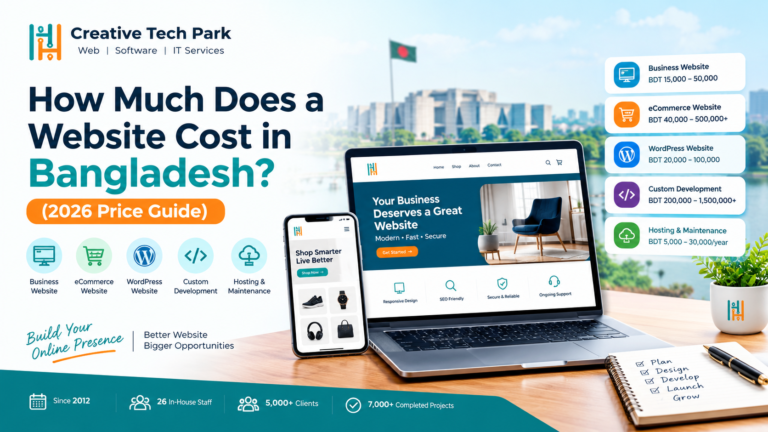
The following ranges are illustrative planning estimates in Bangladeshi taka, not verified quotations or fixed market prices. Actual prices should be confirmed through current proposals from qualified providers.
| Website type | Illustrative development budget |
|---|---|
| Basic business website | BDT 20,000–60,000 |
| Professional corporate website | BDT 60,000–200,000 |
| Custom business website with advanced features | BDT 150,000–500,000 |
| E-commerce website | BDT 80,000–500,000+ |
| Complex web application or business portal | BDT 300,000–2,000,000+ |
These ranges overlap because the word “custom” covers projects of very different sizes. A technically complex e-commerce platform can cost substantially more than a basic corporate website, while a modest custom feature may be affordable within an otherwise standard site.
What Determines the Development Cost?
1. Number of Pages and Design Complexity
A website with five straightforward pages usually requires less work than one with dozens of unique layouts, detailed product catalogues, and extensive resource libraries.
The important factor is not page count alone. A single interactive application screen may require more development than several standard content pages.
2. Custom Features
Advanced search, customer dashboards, booking systems, membership access, reporting tools, and automated workflows increase development effort.
Each feature should have a clear purpose and a defined set of acceptance criteria.
3. Integrations
Connecting a website to an accounting platform, CRM, inventory system, payment gateway, or external API may involve additional development and testing.
Integration costs depend on the availability and quality of the external system’s documentation, access permissions, API limitations, and the complexity of data exchange.
4. Content and SEO
Professional copywriting, product descriptions, photography, content migration, keyword research, and technical SEO may be included in the project or priced separately.
Businesses should clarify exactly what is covered. A proposal that includes website development does not necessarily include comprehensive SEO services or the creation of every page’s content.
5. Hosting, Maintenance, and Support
The total cost of ownership includes more than the initial development fee.
Potential recurring expenses include:
- Domain registration.
- Hosting and server resources.
- Premium themes or software licences.
- Email services.
- Backup and security services.
- Technical maintenance.
- Content updates.
- Paid third-party integrations.
- Future feature development.
A lower initial price may not represent better value if the website is difficult to maintain or requires expensive redevelopment shortly afterward.
How to Prepare a Realistic Website Budget
Before requesting quotations, write down your essential requirements and decide what you can reasonably invest.
Ask each provider to separate design, development, content, integrations, hosting, maintenance, and any third-party fees. This makes proposals easier to compare.
Also clarify payment milestones, expected delivery dates, revision limits, change-request procedures, warranty terms, and the conditions for receiving the source code and administrative credentials.
The objective is not to choose the lowest price. It is to find a solution that fits your business needs and budget without creating avoidable long-term costs.
How Long Does Custom Website Development Take?
Project timelines depend on the scope of work, the availability of content, the number of approval stages, and the complexity of the required functionality.
The following are general planning estimates rather than delivery guarantees.
| Project type | Indicative timeline |
|---|---|
| Basic business website | 2–4 weeks |
| Professional corporate website | 4–8 weeks |
| Custom website with multiple integrations | 8–16 weeks |
| Complex web application | 3–6 months or longer |
A simple website may be delayed if the company cannot provide its content or approve the design on time. A technically complex project may need additional testing, security reviews, and integration work.
Businesses can reduce delays by appointing one decision-maker, preparing content early, reviewing milestones promptly, and avoiding unplanned changes during development.
How to Choose the Best Website Development Company in Dhaka
Choosing a development partner is a business decision that can affect your website’s cost, reliability, and future flexibility.
A professional presentation is useful, but it is not enough. You need evidence that the company can understand your requirements, communicate clearly, and deliver an appropriate solution.
Review Relevant Portfolio Projects
Ask to see completed projects that resemble your requirements.
A provider experienced in corporate websites may not automatically be the best choice for a complex inventory application. Look for relevant functionality, appropriate design quality, and examples of projects with similar business objectives.
Where possible, inspect live websites on desktop and mobile devices.
Assess Technical Capability
Ask the team how it would approach your requirements and why it recommends a particular technology.
Useful questions include:
- How will the website be structured?
- Which parts will be custom-built?
- How will performance be tested?
- How will the website be secured?
- What happens if a third-party integration fails?
- Can the business add features later?
- Who will maintain the website after launch?
You do not need to be a developer to evaluate whether the answers are clear, practical, and consistent.
Confirm Ownership and Access
The contract should explain who owns the website’s design, source code, original content, and custom-developed components.
It should also specify access to the domain registrar, hosting account, content management system, database, source repository, and relevant third-party accounts.
Where open-source software or licensed components are used, the agreement should explain the applicable licence restrictions.
Avoid arrangements that leave your business unable to access its own website or move to another provider.
Understand Post-Launch Support
Websites need maintenance as software changes, security issues emerge, and business requirements evolve.
Before signing a contract, confirm whether the provider offers technical support, backups, software updates, security monitoring, bug fixes, and ongoing development.
Ask about response times, support hours, exclusions, and charges for work outside the agreement.
A clear support arrangement is especially important for e-commerce websites and systems that support daily business operations.
Compare Proposals Carefully
Request written proposals from providers that understand your project.
Compare the scope of work, deliverables, technical approach, schedule, exclusions, ownership terms, payment milestones, and support arrangements.
A proposal that explains how the solution will work is generally more useful than one that simply promises a modern design and fast delivery.
Common Website Development Mistakes Businesses Should Avoid
Even a well-funded project can underperform when important decisions are overlooked.
Choosing a Provider Based Only on Price
Low-cost development may be appropriate for a simple project, but an unusually low quotation can also indicate missing features, limited testing, unclear ownership terms, or little post-launch support.
Compare the actual deliverables before deciding.
Ignoring Mobile Users
A website that is difficult to navigate on a phone can discourage potential customers from contacting the business.
Review important user journeys on mobile, including contact forms, account registration, booking, and checkout.
Starting Without a Clear Strategy
A business should not begin development simply because competitors have websites.
Identify the audience, desired actions, required content, and measurable objectives first. Otherwise, the finished website may look attractive without solving the problems that justified the investment.
Adding Too Many Features at Launch
Businesses sometimes request every possible feature before understanding whether customers need them.
A better approach is to prioritise essential functionality, launch a reliable first version, collect feedback, and introduce improvements based on evidence.
Neglecting Website Content
Visitors need clear answers about services, pricing approaches, delivery processes, company experience, and next steps.
Poorly written or incomplete content weakens the effectiveness of even an attractive design. Prepare the important content early and ensure that all claims are accurate.
Treating SEO as an Afterthought
Changing URL structures, publishing thin pages, omitting metadata, or blocking important pages from search engines can create avoidable problems.
Include technical SEO, content planning, and migration requirements in the original project scope.
Forgetting Maintenance
An unsupported website can become vulnerable to security issues, software incompatibilities, and performance problems.
Assign responsibility for updates, backups, monitoring, and technical support before the site goes live.
Custom Website Development and Business Growth
A well-planned website can support several areas of business growth, provided its design and functionality align with the company’s actual needs.
Lead Generation for B2B Companies
B2B purchasing decisions often involve research, comparisons, internal discussions, and approval from multiple people.
A useful business website should explain services clearly, provide relevant evidence, and make it easy to request a consultation or quotation.
Detailed service pages, case studies, industry-specific content, and structured enquiry forms can help sales teams receive better-informed enquiries.
For example, a software company could use its website to explain its development process, describe relevant project experience, and collect information about a prospect’s business requirements before arranging a meeting.
Supporting E-Commerce Operations
An online store can help a retailer present products outside its physical location and accept orders through a structured process.
However, the website must be supported by reliable stock management, accurate product information, customer service, delivery operations, and suitable payment arrangements.
The most effective e-commerce investment is one that improves the complete customer journey rather than concentrating only on the visual design.
Improving Customer Service
Frequently requested information can be made available through service pages, FAQs, account portals, booking systems, and order status tools.
This may reduce repetitive enquiries and allow staff to focus on more complicated customer needs.
The features should be based on real support patterns rather than assumptions about what customers want.
Creating Opportunities for Automation
A custom website can become the starting point for broader business automation.
Depending on the system architecture, it may send enquiry details to a CRM, notify staff about new orders, generate booking confirmations, or exchange information with an inventory platform.
Automation should be introduced with clear rules, error handling, and monitoring. A poorly configured workflow can create as many problems as it solves.
Measuring the Return on Investment of a Business Website
A website’s value should be assessed against its business objectives.
Traffic is useful, but it does not tell the whole story. A website attracting thousands of irrelevant visitors may generate less commercial value than one attracting a smaller number of qualified prospects.
Choose a few key performance indicators that reflect the intended outcome.
For a B2B website, useful metrics may include:
- Qualified enquiries generated.
- Conversion rate on important landing pages.
- Cost per lead from paid campaigns.
- Sales opportunities influenced by website content.
- Organic search traffic to relevant service pages.
- Enquiry-to-customer conversion rate.
For an e-commerce website, metrics may include completed orders, conversion rate, average order value, checkout abandonment, and revenue from different acquisition channels.
A Simple Example of Website ROI
Suppose a business invests BDT 150,000 in a website and spends another BDT 30,000 on relevant annual hosting and maintenance.
Its first-year investment is BDT 180,000.
If the website contributes to 12 new customers during that year and the average gross profit attributable to each customer is BDT 25,000, the total gross profit associated with those customers would be BDT 300,000.
Using a simplified calculation:
ROI = (Gross profit attributable to the website − Total website investment) ÷ Total website investment × 100
In this example:
ROI = (BDT 300,000 − BDT 180,000) ÷ BDT 180,000 × 100
The result is approximately 66.7%.
This is an illustrative scenario, not a guaranteed outcome. Businesses must account for attribution, sales costs, repeat purchases, and other relevant expenses to assess actual profitability.
The important point is to measure business results rather than judging a website entirely by its appearance.
The Future of Custom Website Development
Website technology continues to evolve, but businesses should adopt new capabilities when they solve a practical problem.
Artificial Intelligence and Smart Automation
AI-powered tools can support customer enquiries, content discovery, document search, and internal workflows.
For example, a business website may offer a carefully configured assistant that helps visitors locate product information or directs enquiries to the appropriate department.
Such tools require appropriate testing, clear limitations, and safeguards for personal information. AI should not be presented as a substitute for reliable human support when customers need complex or sensitive assistance.
API-Based Integrations
Businesses increasingly use multiple software systems to manage sales, finance, operations, marketing, and customer support.
API-based integrations can allow these systems to exchange information when supported by the relevant platforms.
Before implementing an integration, the development team should confirm API availability, access permissions, data formats, usage limits, and the consequences of service interruptions.
Accessibility and Inclusive Design
An accessible website is easier for a wider range of people to use.
Good practices include sufficient colour contrast, meaningful alternative text, keyboard navigation, clear form labels, descriptive links, and logical heading structures.
Accessibility should be considered during design and development rather than treated as a final visual adjustment.
Sustainable Technical Architecture
A website should be built so that it can be maintained without unnecessary difficulty.
Readable code, appropriate documentation, reliable testing, controlled dependencies, and clear ownership make future improvements easier.
The best architecture is not necessarily the most complicated. It is the one that meets current requirements and supports realistic future needs without imposing excessive maintenance costs.
Why Consider Creative Tech Park for Custom Website Development in Bangladesh?
Selecting a website development partner means choosing a team that will help translate business requirements into a working digital solution.
Creative Tech Park is a Dhaka-based web design, software development, and IT services agency that has operated since 2012. The company reports a team of 26 in-house staff, more than 5,000 clients, and over 7,000 completed projects.
These figures provide useful background when evaluating the company, but businesses should also assess the relevance of its portfolio, the proposed project team, the technical approach, and the specific deliverables offered for their requirements.
Solutions Based on Business Requirements
A professional development project should begin with an understanding of the organisation’s goals, target audience, required functionality, and operating processes.
For a corporate website, the priorities may be professional presentation, clear service pages, and lead generation. For an online store, they may include product management, checkout reliability, and order handling. For a business application, workflow accuracy, permissions, integrations, and data management may matter most.
The right solution depends on the problem being solved.
A Focus on Usability and Performance
Business websites should be easy to navigate, work well across devices, and provide a clear path to the next action.
Design, development, content structure, performance, and SEO should work together. A visually attractive website is more useful when it also helps visitors find information and complete tasks.
Planning Beyond the Launch Date
A website should be prepared for ongoing operation.
That means considering content updates, security, backups, analytics, maintenance, and future feature requirements during the planning stage.
Businesses should discuss these responsibilities with Creative Tech Park before approving a project so that the final agreement clearly defines what is included and what will require additional investment.
A Practical Starting Point
Before requesting a proposal, prepare a short description of your business, the audience you want to reach, the main problem the website should solve, the features you require, and your approximate budget.
This gives the development team a stronger foundation for estimating the scope and recommending an appropriate solution.
To explore available services and discuss your requirements, visit the official Creative Tech Park website at https://creativetechpark.com/. Confirm the current service offerings, portfolio, and contact details directly with the company.
Frequently Asked Questions About Custom Website Development
What is custom website development?
Custom website development is the process of building a website around specific business requirements. It may include tailored design, specialised functionality, third-party integrations, and a content management system suited to the organisation.
How much does custom website development cost in Bangladesh?
The cost depends on the project’s scope, complexity, design requirements, integrations, content, and ongoing support needs. A basic business website may require a relatively modest budget, while an advanced e-commerce platform or business application can cost substantially more. Request a detailed quotation based on your requirements.
How long does it take to develop a custom website?
A basic business website may take a few weeks, while a professional corporate website may require several weeks or longer. Complex platforms can take several months. Content readiness, stakeholder approvals, and feature complexity all affect the timeline.
Is custom website development better than WordPress?
Neither option is universally better. WordPress can be an excellent choice for corporate websites, blogs, and many online stores. Custom development is useful when specialised workflows, integrations, or functionality cannot be supported efficiently by an existing platform.
Is custom website development suitable for small businesses?
Yes, when the investment is justified by the business requirements. A small company may benefit from a tailored booking system, customer portal, or specialised service website. However, a standard WordPress website or website builder may be more economical when requirements are simple.
Will a custom website rank higher on Google?
Custom development does not guarantee higher rankings. A well-built website can provide a sound technical SEO foundation through good performance, logical structure, mobile usability, and proper indexing. Search visibility also depends on content quality, relevance, competition, links, and ongoing optimisation.
Can I update the website without hiring a developer?
Yes, if the project includes a suitable content management system and appropriate administrative tools. Routine tasks such as editing service descriptions, publishing articles, and changing images can often be managed by authorised staff. More advanced functionality may still require developer support.
Who owns the website after development?
Ownership depends on the contract, applicable licences, and the assets involved. Before signing, clarify rights to the source code, custom design, original content, domain, hosting, database, and third-party components. Ensure that your business receives the access and documentation specified in the agreement.
Does a business website need ongoing maintenance?
Yes. Maintenance may include software updates, security monitoring, backups, performance checks, compatibility testing, and bug fixes. The level of maintenance required depends on the website’s technology, complexity, and business importance.
What should I prepare before hiring a website development company?
Prepare your business goals, target audience, preferred website structure, essential features, available content, examples of websites you like, expected timeline, and budget range. A clear brief helps the provider prepare a more accurate proposal.
Final Thoughts: Build a Website Around Your Business Goals
Custom website development is most valuable when it addresses a genuine business need.
The right website can help a company communicate more clearly, attract relevant prospects, support online sales, streamline customer interactions, and create a foundation for future digital improvements. Achieving those benefits requires more than attractive design. It takes clear planning, suitable technology, useful content, reliable testing, and ongoing maintenance.
For businesses in Dhaka and across Bangladesh, the first step is to identify what the website needs to accomplish and how success will be measured. From there, compare development approaches, define the required functionality, establish a realistic budget, and select a partner that can explain its proposed solution clearly.
Creative Tech Park offers a starting point for businesses seeking web design, software development, and IT services. Review its relevant work, discuss your objectives, and request a detailed proposal before making a decision.
Ready to plan your next business website? Visit https://creativetechpark.com/ to explore Creative Tech Park and discuss a solution aligned with your business requirements.
A well-planned website should not simply represent your business online. It should help your business work better.
- E-commerce Website Development
- SEO-Friendly Website Development
- Software Development Company in Bangladesh
- Web Application Development
- Website Development Cost in Bangladesh
- Website Development Process
- Website Redesign Services
- WordPress Website Development

Written by
masum
Part of the Creative Tech Park team in Dhaka, Bangladesh, building websites, apps and business software since 2012.