How to Rank on Google in 2026: The Complete SEO Guide for Businesses in Bangladesh

In this article
- 1. Understanding How Google Ranking Works in 2026
- 2. Start With Keyword Research That Matches Customer Intent
- 3. Create Helpful Content That Deserves to Rank
- 4. On-Page SEO: Optimize Every Important Element
- 5. Technical SEO: Make Your Website Easy to Crawl and Use
- 5.1 Set Up Google Search Console
- 5.2 Create and Submit an XML Sitemap
- 5.3 Check Robots.txt and Indexing Directives
- 5.4 Use HTTPS and Maintain Website Security
- 5.5 Fix Broken Links, Redirects, and Duplicate URLs
- 5.6 Improve Core Web Vitals and Page Speed
- 5.7 Build a Mobile-Friendly Website
- 5.8 Avoid Unnecessary Technical Complexity
- 6. Off-Page SEO: Build a Credible Online Reputation
- 7. Local SEO for Businesses in Dhaka and Across Bangladesh
- 8. Improve Website Content With Topic Clusters and Internal Links
- 9. Measure SEO Performance With Google Search Console and Analytics
- 10. A Practical 90-Day SEO Plan for a Bangladeshi Business
- 11. Common SEO Mistakes That Prevent Better Rankings
- 12. How to Choose an SEO Agency in Bangladesh
- 13. SEO for WordPress and Custom Laravel Websites
- 14. The Role of Google Search Features and AI Search in 2026
- 15. Frequently Asked Questions About How to Rank on Google
- How long does it take to rank on Google?
- Can a new website rank on Google?
- Is SEO free?
- Is keyword density important?
- Do backlinks still matter in 2026?
- Does website speed directly determine rankings?
- Can I rank on Google without a blog?
- Is WordPress better than Laravel for SEO?
- Should I create a separate page for every keyword?
- How can a small business compete with large websites?
- What is the most important first step?
- 16. Your Next Steps: Turn SEO Into a Business Growth Strategy
Learning how to rank on Google is essential for businesses that want to attract customers, build trust, and generate consistent website traffic in 2026. A well-planned Search Engine Optimization (SEO) strategy helps your business appear when potential customers search for your products, services, or expertise online.
However, ranking on Google requires more than adding keywords to a webpage. You need useful content, a technically sound website, a clear understanding of search intent, strong internal links, trustworthy business information, and a consistent approach to measuring results.
For Bangladeshi businesses, the opportunity is significant. Whether you operate a software company in Dhaka, an online clothing store, a professional service agency, a restaurant, or a growing startup, SEO can help you reach people who are actively looking for what you offer.
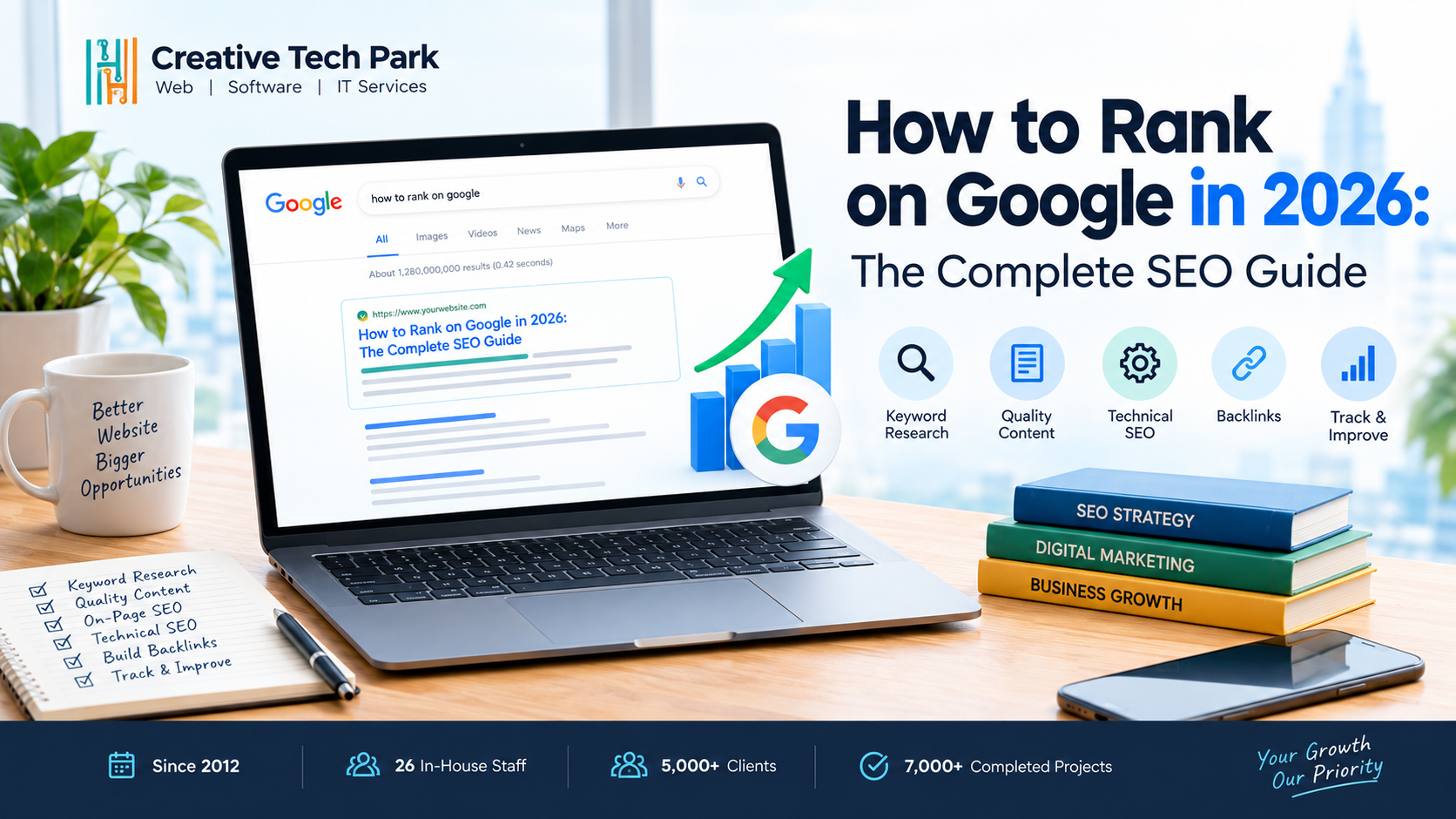
This guide explains how Google ranking works, how to find the right keywords, how to optimize your website, how to create content that deserves visibility, and how to build a practical SEO strategy for long-term growth.
1. Understanding How Google Ranking Works in 2026
Before investing time and money in SEO, you need to understand how Google discovers, evaluates, and ranks webpages. This knowledge helps you make better decisions instead of relying on outdated tricks or promises of instant results.
Google’s search systems aim to provide useful, relevant results that satisfy the user’s needs. They consider many signals, including the relevance of a page, the quality of its content, the context of the search, and the overall usefulness of the result.
No single optimization guarantees a first-page ranking.
1.1 How Google Finds and Ranks Your Website
Google Search generally involves three main stages: crawling, indexing, and serving search results.
Crawling: Google uses automated programs called crawlers to discover webpages by following links and reading sitemaps. If your important pages cannot be accessed, Google may struggle to discover their content.
Indexing: After discovering a page, Google analyzes its content and other information to determine whether it should be included in its search index. A page can be crawled without being indexed.
Ranking: When someone searches for information, Google’s systems evaluate relevant pages and determine which results are most appropriate for that query.
These stages are related, but they are not the same. Submitting a sitemap does not guarantee indexing, and indexing does not guarantee high rankings.
For example, imagine a Dhaka-based software company publishes a page about custom website development. If Google can crawl the page, understand its purpose, and consider it relevant to a searcher’s needs, the page may become eligible to appear for related searches.
Its actual position will depend on competition, content quality, relevance, authority signals, and other factors.
1.2 What Matters Most for Google Rankings?
A practical SEO strategy focuses on several interconnected areas.
- Search intent: Does your page answer the question or solve the problem behind the search?
- Content quality: Is the information accurate, useful, sufficiently detailed, and easy to understand?
- Technical SEO: Can search engines access and interpret your website correctly?
- On-page SEO: Are the page title, headings, content, images, and links organized clearly?
- Website reputation: Do credible sources, relevant mentions, and useful references support your business’s credibility?
- User experience: Can visitors navigate your website, read your content, and complete important actions comfortably?
- Local relevance: For location-based services, does your website provide clear, consistent information about your business and service area?
These elements work together. A technically perfect website may struggle if its content does not meet search intent. Equally, an excellent article may receive little traffic if important technical problems prevent Google from indexing it.
1.3 Can You Guarantee a First-Page Ranking?
No ethical SEO professional can guarantee a particular Google position for every keyword.
Search results change as competitors publish better pages, user needs evolve, and Google’s systems are updated. Results may also vary by location, language, device, and query.
Be cautious when an agency promises number-one rankings within a fixed number of days. Ask instead about its research process, deliverables, reporting methods, and previous work.
A reliable SEO campaign measures progress through relevant rankings, organic clicks, qualified enquiries, conversions, and revenue—not rankings alone.
2. Start With Keyword Research That Matches Customer Intent
Keyword research is the foundation of an effective SEO campaign. It helps you discover what potential customers search for, how they describe their problems, and which topics your website should cover.
The objective is not to collect the largest possible list of keywords. It is to identify the searches most relevant to your business and create pages that satisfy them.
2.1 Choose One Primary Keyword for Each Important Page
Every major landing page or article should have a clear primary topic.
For this article, the primary keyword is how to rank on Google. Related phrases include:
- How to improve Google rankings
- Google SEO guide for beginners
- Search engine optimization in Bangladesh
- On-page SEO techniques
- Technical SEO checklist
- How to get organic traffic
- Local SEO for small businesses
- Google Search Console tutorial
These related phrases help define the subject’s scope. They should appear only where they fit naturally.
Do not force every variation into the article. Google can understand related concepts without requiring repetitive exact-match keywords.
For a Bangladeshi web development company, useful commercial keywords might include “web design company in Dhaka,” “custom software development in Bangladesh,” or “e-commerce website development company.”
A page targeting potential customers should explain the service, its benefits, the process, and the next steps. A general educational article should focus on teaching rather than repeating a sales pitch.
2.2 Understand the Four Main Types of Search Intent
Search intent describes what a person wants to accomplish when entering a query.
Informational intent: The searcher wants to learn something.
Examples: “What is technical SEO?” and “How does Google indexing work?”
Navigational intent: The searcher wants to reach a particular website or resource.
Examples: “Google Search Console” or a search for a known company by name.
Commercial investigation: The searcher is comparing options before making a decision.
Examples: “Best SEO agency in Dhaka” and “WordPress versus custom website development.”
Transactional intent: The searcher is ready to take action.
Examples: “Hire an SEO company in Bangladesh” or “Request a website development quote.”
Your content should reflect the intent behind the keyword. Someone searching for an SEO definition probably does not need a lengthy pricing form at the top of the page. Someone looking for an SEO agency may want service details, evidence of experience, pricing guidance, and a contact option.
Matching the page to the searcher’s goal is more useful than chasing search volume alone.
2.3 Find Keywords With Google Search Console and Keyword Tools
You do not need an expensive SEO subscription to begin keyword research.
Start with these resources:
- Google Search Console: Discover queries that already generate impressions and clicks for your website.
- Google Keyword Planner: Research keyword ideas and advertising-related search estimates.
- Google Trends: Compare interest in topics over time and explore geographic patterns.
- Google search suggestions: Find variations people commonly enter while searching.
- Related searches and relevant question formats: Discover additional questions and subtopics worth addressing.
- Professional SEO tools: Platforms such as Ahrefs and Semrush can help with competitor research, keyword difficulty estimates, backlink analysis, and content planning.
Each tool has limitations. Search volume estimates are not exact forecasts, and keyword difficulty scores are third-party estimates rather than official Google ranking measurements.
For a new website, consider targeting specific, relevant searches that larger competitors may not address thoroughly. These are often called long-tail keywords.
For example, “SEO services for small businesses in Dhaka” is more specific than “SEO.” It may attract fewer searches, but those searches can be more relevant to a company offering that service.
2.4 Analyze Search Results Before Writing
Once you have a promising keyword, search for it and examine the results.
Ask yourself:
- What type of pages rank: guides, service pages, product pages, or local business listings?
- What questions do the strongest pages answer?
- Are the results focused on beginners or experienced professionals?
- Is the information current and specific to the intended audience?
- What important details are missing from existing results?
- Can your page provide a more useful explanation, better examples, or clearer instructions?
Do not simply copy the structure or wording of competing pages. Use the results to understand the task users want to complete, then create original content that serves that task more effectively.
For example, a guide about SEO for Bangladesh should include practical considerations such as mobile visitors, local service areas, business listings, and customer enquiries. Adding these details can make the article more useful to its intended audience.
2.5 Build a Keyword-to-Page Map
Before publishing many articles, organize your keywords into a simple content plan.
| Page type | Example target keyword | Main purpose |
|---|---|---|
| Homepage | Web design company in Dhaka | Introduce the business |
| Service page | Custom software development in Bangladesh | Generate qualified enquiries |
| Educational guide | How to rank on Google | Attract informational traffic |
| Supporting article | Technical SEO checklist | Answer a specific question |
| Case study | E-commerce website development case study | Demonstrate practical experience |
| Location page | SEO services in Dhaka | Serve a genuine local audience |
Assigning a primary topic to each page helps prevent keyword cannibalization, a situation where multiple pages compete for similar searches without serving clearly different purposes.
If two pages target almost identical needs, consider improving one comprehensive page or making the purpose of each page more distinct.
3. Create Helpful Content That Deserves to Rank
Content is central to SEO because Google needs to understand what a page offers and whether it is relevant to a search.
However, publishing thousands of words does not automatically make a page valuable. The content must answer the right questions, provide reliable information, and help readers accomplish something.
3.1 Write for People First, Not Search Engines Alone
Start with the reader’s problem.
If your target audience consists of business owners who want to improve Google rankings, explain the process in clear language. Define technical terms, provide realistic examples, and identify mistakes readers can avoid.
A useful article typically includes:
- A clear answer to the main question
- Logical sections that move from basic concepts to practical steps
- Relevant examples and supporting evidence
- Actionable recommendations
- Links to reliable resources
- A clear explanation of limitations or common misconceptions
Avoid adding paragraphs merely to increase word count. Remove material that repeats an earlier point without adding new information.
Long-form content can work well when a subject genuinely requires detailed treatment. Shorter pages can perform equally well when they satisfy the searcher’s need more directly.
3.2 Demonstrate Experience, Expertise, Authority, and Trust
Google’s quality guidance emphasizes the importance of content that demonstrates experience, expertise, authoritativeness, and trustworthiness. These concepts are often summarized as E-E-A-T.
E-E-A-T is not a single score that website owners can optimize. It is a useful framework for thinking about content quality and credibility.
For a business website, practical ways to demonstrate these qualities include:
- Publishing accurate company information
- Identifying authors or qualified reviewers when appropriate
- Explaining how recommendations were developed
- Providing original examples, screenshots, or case studies
- Citing trustworthy sources for important factual claims
- Updating outdated information
- Correcting errors when they are discovered
- Making contact information and business policies easy to find
Suppose a software agency publishes an article about website security. A generic list of security tips may help readers, but an explanation of common implementation problems, practical testing steps, and relevant technical references can provide greater value.
Never invent client results, testimonials, qualifications, project counts, or performance statistics. Trust is easier to build when claims can be substantiated.
3.3 Use AI Tools Responsibly in Content Production
AI writing tools can help with research organization, outlines, editing, and identifying missing topics. Their output still requires human review.
A responsible workflow includes checking facts, verifying sources, adding original insights, reviewing examples, and editing the final article for accuracy and clarity.
Publishing large quantities of unreviewed, repetitive, or unoriginal pages primarily to manipulate search rankings can violate Google’s spam policies. The issue is not simply whether AI was used; the purpose, originality, and usefulness of the content matter.
For example, a business could use AI to draft an outline for a guide to e-commerce SEO. Its specialists should then verify the technical recommendations, add practical experience, test examples where possible, and remove unsupported claims.
The final article should offer genuine value whether or not the reader knows which tools assisted in its preparation.
3.4 Cover the Topic Thoroughly Without Repeating Yourself
A comprehensive guide should address the main question and the most important supporting questions.
For an SEO guide, that may include keyword research, content creation, technical SEO, internal linking, backlinks, local search, measurement, and common mistakes.
Use a logical hierarchy:
- H1 for the main article title
- H2 for major sections
- H3 for subsections
- H4 for smaller supporting topics where necessary
Use descriptive headings rather than inserting keywords into every heading. A reader should be able to scan the page and understand its structure.
Also, provide a useful introduction, meaningful examples, and a clear next step. These details often improve the reading experience more than adding another thousand words.
3.5 Keep Content Accurate and Updated
An article about SEO in 2026 should not rely entirely on advice written many years ago.
Review important pages when Google changes its documentation, when a technical recommendation becomes outdated, or when new evidence makes an earlier explanation inaccurate.
An effective content review process checks:
- Whether the facts and references remain correct.
- Whether the page answers the intended search query.
- Whether screenshots, links, and examples still work.
- Whether important user questions remain unanswered.
- Whether the page generates useful engagement or business outcomes.
Update a page when meaningful improvements are necessary. Changing the publication date without making substantive improvements does not automatically improve its ranking.
4. On-Page SEO: Optimize Every Important Element
On-page SEO helps search engines and visitors understand the subject of an individual webpage.
It includes titles, headings, page content, images, links, and the way information is presented.
4.1 Write a Clear and Compelling SEO Title
The HTML title element helps Google understand a page’s subject and can influence the title shown in search results. Google may generate a different title link when it believes another version better represents the page.
For this article, a suitable title is:
How to Rank on Google in 2026: Complete SEO Guide
A strong SEO title should:
- Describe the actual content
- Include the main topic naturally
- Be distinctive from other page titles
- Set an accurate expectation
- Avoid repetitive keyword lists and exaggerated claims
There is no universally guaranteed title-character limit that ensures Google will display the entire title. Search result presentation varies by device and context, so prioritize clarity and relevance over an arbitrary character count.
4.2 Create a Useful Meta Description
A meta description provides a short summary of the page. Google may use it as the search snippet, although it can also select relevant text from the page itself.
Example:
Meta description: Learn how to rank on Google in 2026 with practical SEO strategies for keyword research, helpful content, technical optimization, backlinks, and local search.
The description should accurately summarize the page and give searchers a reason to visit.
A meta description is not a direct ranking boost simply because it contains a keyword. Its main purpose is to communicate relevance and potentially improve the quality of search-result clicks.
4.3 Optimize Your URL Structure
Use short, descriptive URLs that clearly indicate the page topic.
Example:
Avoid unnecessary parameters, random strings, and excessive folder structures when they do not serve a practical purpose.
For existing pages, do not change URLs merely to make them slightly shorter. If a URL must change, implement an appropriate permanent redirect, update internal links, and check canonical tags and sitemap entries.
Consistent URL management helps users and search engines navigate the site without creating avoidable indexing problems.
4.4 Use Headings to Organize Information
Headings should describe the content that follows them.
For example:
- H1: How to Rank on Google in 2026
- H2: Keyword Research and Search Intent
- H3: How to Find Long-Tail Keywords
- H2: Technical SEO
- H3: Improving Page Speed and Mobile Usability
Use heading levels according to the document’s structure, not simply to change font size.
A well-organized article is easier to scan, maintain, and expand as the topic develops.
4.5 Use Keywords Naturally
Place your primary keyword where it accurately describes the page, particularly in the title, main heading, introduction, and relevant sections.
Use related terms where they add meaning. Avoid repeating the same phrase in every paragraph.
There is no universal keyword-density percentage that guarantees better rankings. A page should use language that sounds natural to its intended readers.
For example, instead of repeatedly writing “how to rank on Google,” you can explain how to improve organic visibility, optimize a page, fix indexing issues, or attract qualified search traffic.
4.6 Optimize Images for Search and Performance
Images can explain complex ideas, demonstrate products, and improve a page’s usefulness.
Follow these practices:
- Use relevant, properly licensed images.
- Compress image files to reduce loading time.
- Choose appropriate dimensions for the displayed layout.
- Use descriptive filenames, such as
technical-seo-checklist.webp. - Write meaningful alternative text when the image conveys information.
- Leave decorative images with empty alternative text where appropriate.
- Use responsive image techniques when supported by your website.
- Provide image captions when they add useful context.
Alternative text should describe the image’s purpose, not serve as a place to insert repeated keywords. A chart showing organic traffic growth, for example, should have alternative text that communicates what the chart illustrates.
Use modern formats such as WebP or AVIF where appropriate and supported by your workflow. Keep image quality suitable for the design while avoiding unnecessarily large files.
4.7 Improve Internal Linking
Internal links connect related pages on your website.
They help visitors discover additional information and help search engines understand the relationships between pages.
Suppose a software agency publishes a guide to SEO. It could link naturally to its website development service, technical SEO checklist, and relevant case studies.
Use descriptive anchor text that explains the destination. “Read our technical SEO checklist” is more informative than repeatedly using “click here.”
Review important pages for broken links, orphaned pages, and links that point to outdated destinations. An orphaned page is a page with no internal links pointing to it, which can make discovery more difficult.
Do not add links simply to increase their number. Each link should serve a clear purpose.
4.8 Add Structured Data When Appropriate
Structured data is a standardized format that helps search engines interpret specific information about a page or entity.
Depending on the page, relevant schema types may include:
- Organization
- LocalBusiness
- Article
- BreadcrumbList
- Product
- Person
Choose a schema type that accurately represents the visible content and your actual business.
For example, an agency may use Organization structured data to identify its name, website, logo, and relevant official profiles. An article may use Article markup to describe its headline, author, and publication details.
Valid structured data can make a page eligible for certain search features, but it does not guarantee enhanced search appearance or a higher ranking.
Use Google’s Rich Results Test where applicable and check relevant reports in Search Console. Avoid marking up information that is false, hidden from users, or inconsistent with the page.
5. Technical SEO: Make Your Website Easy to Crawl and Use
Technical SEO addresses the website infrastructure that allows search engines to access, process, and understand your pages.
Technical problems can prevent good content from reaching its intended audience. For that reason, technical checks should be part of every SEO campaign.
5.1 Set Up Google Search Console
Google Search Console is one of the most useful free resources for website owners.
It provides information about search performance, indexing, sitemap processing, and certain website issues.
A practical setup process is:
- Open Google Search Console.
- Add your website as a property.
- Verify ownership using an available verification method.
- Submit your XML sitemap if you have one.
- Review the Pages indexing report.
- Check the Performance report for impressions, clicks, and queries.
- Inspect important URLs when investigating indexing problems.
- Review relevant notifications and enhancement reports.
Search Console is not a direct ranking control panel. It helps you understand how Google sees your site and where further investigation may be needed.
5.2 Create and Submit an XML Sitemap
An XML sitemap lists URLs you want search engines to discover.
It is particularly useful for larger websites, new websites, and sites with complex structures. However, internal linking remains important, and a sitemap does not force Google to index every listed URL.
Check that your sitemap contains the correct canonical URLs and excludes pages that should not be indexed.
For WordPress websites, many SEO plugins can generate sitemaps automatically. For custom Laravel websites, developers can create a sitemap through an application route, scheduled process, or other suitable method.
Keep sitemap entries current when important pages are added, removed, or redirected.
5.3 Check Robots.txt and Indexing Directives
The robots.txt file controls crawler access to specified paths. It does not, by itself, guarantee that blocked URLs will be excluded from Google’s index.
The noindex directive is a different mechanism. Search engines must be able to crawl a page to see a noindex instruction in its HTML or response headers.
This distinction matters. Accidentally blocking a page that contains a noindex instruction may prevent Google from discovering that instruction.
Before making changes, check whether the page is intended to appear in search results and understand the effect of each directive.
For a business website, important public pages should normally be accessible unless there is a clear technical or business reason otherwise. Private customer areas and administrative functions require appropriate access controls rather than relying on robots.txt alone.
5.4 Use HTTPS and Maintain Website Security
HTTPS protects data exchanged between the website and its visitors.
Install and maintain a valid SSL/TLS certificate, redirect HTTP URLs to their preferred HTTPS equivalents, and update internal links where necessary.
Also, keep your content management system, plugins, themes, frameworks, and server software maintained. Apply security updates, use strong authentication, and keep reliable backups.
A compromised website may expose visitors to harm and damage business trust. Security should therefore be treated as an operational requirement, not merely an SEO task.
5.5 Fix Broken Links, Redirects, and Duplicate URLs
Broken internal links create a frustrating experience and can make it harder for visitors and crawlers to navigate your site.
Audit important pages for:
- Internal links returning errors
- Unnecessary redirect chains
- Redirect loops
- Duplicate versions of the same page
- Incorrect canonical tags
- HTTP and HTTPS inconsistencies
- Trailing-slash or parameter-related URL duplication
Use permanent redirects when a page has genuinely moved and a temporary redirect when the move is temporary.
Canonical tags help indicate the preferred version of substantially duplicate or similar pages. They are signals rather than absolute commands, so make them consistent with redirects, internal links, and sitemap URLs.
Do not redirect every removed URL to the homepage. Where possible, redirect to a relevant replacement. If no suitable replacement exists, the appropriate response may be a genuine not-found status.
5.6 Improve Core Web Vitals and Page Speed
Website speed affects usability, particularly for visitors using mobile connections or lower-powered devices.
Google’s Core Web Vitals assess aspects of loading performance, responsiveness, and visual stability.
The current commonly used good thresholds are:
- Largest Contentful Paint (LCP): 2.5 seconds or less.
- Interaction to Next Paint (INP): 200 milliseconds or less.
- Cumulative Layout Shift (CLS): 0.1 or less.
These thresholds are evaluated at the 75th percentile of page visits, separated by mobile and desktop where applicable.
Useful improvements include:
- Compressing oversized images
- Reducing unnecessary JavaScript
- Removing unused CSS where practical
- Improving server response time
- Caching static resources
- Reserving space for images and advertisements
- Loading below-the-fold images efficiently
- Reviewing third-party scripts and plugins
- Using a suitable content delivery network when beneficial
Tools such as PageSpeed Insights and Chrome DevTools can help identify performance problems.
Do not assume that a perfect laboratory score guarantees a high ranking. Real-user data, page usefulness, relevance, and competition also matter.
5.7 Build a Mobile-Friendly Website
Many customers in Bangladesh browse websites on smartphones. A business website should therefore work well on smaller screens as well as desktop computers.
Check that:
- Text is readable without zooming.
- Buttons and links are easy to tap.
- Menus are simple to navigate.
- Important information is not hidden behind intrusive elements.
- Forms work correctly on mobile devices.
- Images fit the available screen width.
- The mobile version contains the same essential information as the desktop version.
Use responsive design rather than maintaining separate content versions without a strong reason.
Test actual pages on different screen sizes. A page can appear acceptable in a desktop browser while presenting serious usability problems on a phone.
5.8 Avoid Unnecessary Technical Complexity
A website does not need an elaborate technology stack to rank well.
WordPress, Laravel, and other platforms can all support effective SEO when they are implemented correctly.
What matters is whether the website serves its intended audience, provides useful content, produces accessible pages, and supports reliable technical maintenance.
For example, a custom Laravel website should provide meaningful page titles, descriptions, canonical URLs, accessible HTML content, crawlable internal links, and appropriate status codes. These features can be built into the application rather than depending on a WordPress plugin.
Choose technology based on business needs, maintenance requirements, security, and performance—not on unsupported claims that one platform automatically ranks better.
6. Off-Page SEO: Build a Credible Online Reputation
Off-page SEO includes activities outside your website that can help establish your business’s visibility and reputation.
Links from relevant, credible websites can help Google discover pages and understand how other sites reference your content. However, the quality and context of those references matter more than simply accumulating a large number of links.
6.1 Earn Backlinks Through Useful Resources
A backlink is a link from another website to your website.
Useful ways to earn legitimate backlinks include:
- Publishing original research or useful industry reports
- Creating practical guides that other publishers may reference
- Contributing expert commentary to relevant publications
- Participating in genuine industry associations
- Sharing meaningful case studies with client permission
- Building useful tools, templates, or reference resources
- Developing relationships with relevant businesses and professional communities
For example, a Bangladeshi software company could publish an original guide to common e-commerce website security issues. If the resource is accurate and genuinely useful, relevant technology publications may choose to reference it.
This is a stronger long-term approach than buying large quantities of low-quality links.
6.2 Avoid Link Schemes and Manipulative Practices
Be cautious of services promising thousands of backlinks, guaranteed domain authority improvements, or rapid ranking gains through private networks.
Google’s spam policies address practices intended to manipulate rankings, including link schemes and certain forms of paid link placement.
Buying or selling links intended to pass ranking credit can create risk. Legitimate advertising and sponsorship are different when properly qualified using appropriate link attributes, such as rel="sponsored" where applicable.
Focus on earning relevant references rather than trying to manufacture signals that appear authoritative.
6.3 Use Digital PR to Increase Visibility
Digital PR combines useful information, expert commentary, original stories, and relationships with publishers.
For a business in Bangladesh, potential topics could include local e-commerce challenges, website security, digital transformation, software adoption, or practical lessons from a properly documented project.
Develop a specific story supported by evidence. Then identify publications or professional communities whose audiences would benefit from it.
Not every mention will include a backlink, and not every backlink will improve rankings. Brand awareness, referral traffic, and business relationships can still make the effort worthwhile.
6.4 Strengthen Brand Consistency
Keep your official business name, website, logo, contact details, and public profiles consistent.
Use accurate company information on relevant business directories and professional platforms. Remove obsolete details where practical.
Do not create fake business profiles or misleading listings to increase visibility.
A clear, consistent identity helps potential customers verify that they have found the right organization and supports a more trustworthy online presence.
7. Local SEO for Businesses in Dhaka and Across Bangladesh
Local SEO helps businesses appear when people search for services in a particular area.
It is especially useful for agencies, consultants, restaurants, clinics, retailers, repair services, and other businesses that serve customers in specific locations.
7.1 Optimize Your Google Business Profile
Eligible businesses can use Google Business Profile to manage how their business information appears across Google Search and Maps.
Start by claiming and verifying your genuine business profile.
Then review the following details:
- Correct business name
- Accurate business category
- Genuine address, when the business qualifies to display one
- Correct service area where applicable
- Current business hours
- Working telephone number
- Official website
- Relevant services
- Genuine business photographs
- Accurate descriptions
Choose categories that reflect your actual business. Do not add keywords to the business name unless they are genuinely part of its real-world name.
Service-area businesses should follow Google’s eligibility rules. A business that does not receive customers at its address generally should not display a residential or other non-customer-facing address publicly.
7.2 Target Local Keywords Naturally
A business serving Dhaka may target relevant phrases such as:
- Web design company in Dhaka
- Software development company in Bangladesh
- SEO services for businesses in Dhaka
- E-commerce website development in Bangladesh
Use these phrases on pages where they accurately describe the service and audience.
A location page should provide genuine local information rather than changing the city name across dozens of nearly identical pages.
For example, a page targeting Dhaka businesses could discuss the agency’s service process, communication arrangements, relevant projects, and the types of organizations it serves.
Only create location pages when the business can provide meaningful information for those locations.
7.3 Collect and Respond to Genuine Customer Reviews
Reviews can influence customers’ decisions and contribute to a business’s local presence.
Ask real customers to share honest feedback after a genuine transaction or completed project. Make the process straightforward and follow Google’s review policies.
Avoid buying reviews, creating fake customer accounts, or offering incentives in exchange for positive ratings.
Respond professionally to both positive and negative feedback. Do not reveal confidential client details when addressing a complaint.
A thoughtful response can show prospective customers that the business takes its responsibilities seriously.
7.4 Publish Useful Local Content
Local content can answer questions that matter to your target audience.
For example, a Dhaka-based software agency could explain how businesses can plan an e-commerce website project, prepare product information, estimate ongoing maintenance needs, and choose suitable payment integrations.
Keep the content relevant to the service and avoid inserting location names where they do not belong.
Local SEO works best when the website, business profile, customer experience, and public reputation reinforce one another.
8. Improve Website Content With Topic Clusters and Internal Links
A topic cluster is a group of related pages organized around a central subject.
The approach helps you plan content systematically and connect broad guides with more specific resources.
For example, an agency could build an SEO content cluster around a central guide titled “The Complete SEO Guide for Businesses.”
Supporting articles might cover:
- Keyword research for service businesses
- Technical SEO troubleshooting
- Website speed optimization
- Local SEO fundamentals
- Internal linking strategies
- Google Search Console reporting
- SEO measurement and conversion tracking
Each supporting article should answer a distinct question and link to the central guide where relevant. The central guide should also link to supporting pages that provide more detailed explanations.
This structure helps readers move from general knowledge to specific tasks without forcing every detail into a single article.
8.1 Prevent Keyword Cannibalization
Publishing multiple articles about almost identical topics can make it difficult to maintain a clear content strategy.
Review pages that target similar queries and compare their purpose, search intent, and performance.
Depending on the findings, you might:
- Keep both pages if they serve genuinely different needs.
- Improve their distinct focus.
- Merge overlapping content into one stronger resource.
- Redirect an outdated page when an appropriate replacement exists.
Do not merge pages solely because they share a keyword. Examine their actual content and search performance first.
8.2 Maintain a Useful Content Update Schedule
A realistic content calendar is better than publishing large quantities of weak articles.
Prioritize pages based on business value, search opportunity, current performance, and the effort required to improve them.
For example, improving a service page that already receives relevant impressions may produce more useful business results than publishing ten unrelated articles.
Track the changes you make, including publication dates, major revisions, internal links, and technical improvements. This makes it easier to evaluate what worked and what requires further attention.
9. Measure SEO Performance With Google Search Console and Analytics
SEO requires measurement because increased traffic does not automatically mean increased revenue.
The right reporting system connects search visibility with meaningful business outcomes.
9.1 Understand the Main SEO Metrics
Impressions: How often your website’s search results were shown under Search Console’s reporting rules.
Clicks: How many clicks your website received from Google Search.
Click-through rate (CTR): The proportion of impressions that resulted in clicks.
Average position: A calculated measure of the position of your highest result for reported impressions, not a guaranteed fixed ranking for every user.
Organic sessions: Visits attributed to organic search in an analytics platform, depending on its reporting and attribution configuration.
Conversions: Valuable actions such as completed enquiry forms, purchases, calls, or qualified lead submissions.
Revenue and lead quality: Measures that help establish whether search traffic contributes to business growth.
Use several metrics together. A page with fewer visits but more qualified enquiries may be more valuable than a page attracting large volumes of irrelevant traffic.
9.2 Use Google Analytics 4 to Understand Visitor Behavior
Google Analytics 4 can help you understand how visitors interact with your website when analytics is properly implemented and configured.
Useful measurements may include:
- Landing pages that attract organic visitors
- Enquiry form submissions
- Product purchases
- Calls or other tracked contact actions
- Engagement with important content
- Differences between traffic sources
- Conversion performance across relevant landing pages
Define conversions around real business goals rather than counting every page view as a success.
For a software agency, a completed project enquiry may be more meaningful than a visitor simply opening the contact page.
9.3 Establish a Baseline Before Making Major Changes
Before starting an SEO campaign, record the current performance of important pages and queries.
Document the reporting period, traffic sources, conversions, and major website changes.
After making improvements, compare equivalent periods where practical. Account for seasonal patterns, promotions, holidays, and other factors that may affect demand.
Avoid attributing every traffic change to SEO. A ranking improvement, an advertising campaign, a brand campaign, and seasonal demand can all influence website performance.
9.4 Turn Data Into Action
Use your reports to identify specific opportunities.
If a page receives impressions but few clicks, examine its search intent, title, snippet, and the competitiveness of the results.
If a page receives clicks but generates few enquiries, review whether the content attracts the right audience and whether the page offers a clear next step.
If an important page is not receiving impressions, investigate indexing, relevance, internal links, and keyword targeting before rewriting the entire article.
If traffic falls sharply, check Search Console, analytics configuration, recent technical changes, and the affected queries before assuming that a Google update is responsible.
The objective is to make informed improvements rather than reacting to every small ranking fluctuation.
10. A Practical 90-Day SEO Plan for a Bangladeshi Business
SEO becomes easier to manage when you divide the work into stages.
The following 90-day plan is a practical starting point for a small or medium-sized business. It is not a promise that rankings will reach a particular level within three months.
Days 1–30: Research, Setup, and Technical Foundations
Start by understanding the website’s current condition.
Week 1: Business and keyword research
- Identify the services or products that matter most.
- Define your target customers and service areas.
- Research primary keywords and related search intent.
- Review relevant competitors.
- Map important keywords to existing or planned pages.
Week 2: Technical checks
- Set up Google Search Console and analytics.
- Verify the sitemap.
- Inspect important URLs.
- Check robots.txt, noindex directives, and canonical tags.
- Test mobile usability and website speed.
- Review HTTPS, broken links, and redirects.
Week 3: On-page improvements
- Rewrite unclear titles and meta descriptions.
- Improve heading structures.
- Update thin or outdated service content.
- Add useful internal links.
- Optimize oversized images.
- Confirm that contact information is correct.
Week 4: Measurement and prioritization
- Record baseline impressions, clicks, and conversions.
- Identify high-priority pages.
- Fix the most serious technical problems.
- Create a realistic content calendar.
- Document completed changes.
At the end of the first month, the goal is to establish a reliable foundation and a clear plan, not to expect every page to reach the first page of Google.
Days 31–60: Publish and Improve Valuable Content
Use the second month to improve the pages that matter most to customers.
Prioritize important service pages. Explain what you offer, who benefits, how the process works, and what customers can expect.
Publish supporting educational content. Choose topics based on search intent, customer questions, and your ability to provide accurate information.
Build internal links. Connect relevant articles, services, and case studies.
Improve credibility. Add genuine project examples, author details, references, and transparent company information where appropriate.
Review performance regularly. Monitor indexing, impressions, clicks, and early signs of user interest.
A new page may take time to gain meaningful visibility. Do not abandon a useful article simply because it has not ranked within a few weeks.
Days 61–90: Evaluate, Refine, and Expand
Use the third month to learn from the available evidence.
- Identify pages gaining impressions or relevant clicks.
- Review queries that differ from your original expectations.
- Improve pages that attract the wrong audience.
- Update titles and content where evidence supports a change.
- Investigate indexing or performance problems.
- Expand successful topic clusters.
- Strengthen internal links to important commercial pages.
- Continue earning legitimate references and business mentions.
- Review lead quality and conversion performance.
At day 90, prepare a report that separates completed work, observed results, unresolved problems, and recommended next steps.
Depending on the website’s age, competition, technical condition, and publishing history, meaningful ranking improvements may take longer than three months.
11. Common SEO Mistakes That Prevent Better Rankings
Even businesses that invest in SEO can waste resources by following outdated or misleading advice.
11.1 Keyword Stuffing
Repeating a keyword unnaturally makes content harder to read and can fall under Google’s spam policies when used manipulatively.
Write for the reader and use relevant terminology where it fits the explanation.
11.2 Publishing Thin or Repetitive Content
Creating many pages with little original value rarely provides a sound long-term strategy.
Focus on pages that answer meaningful questions, offer distinct information, or serve a clear business purpose.
11.3 Buying Low-Quality Backlinks
Large backlink packages can contain irrelevant or manipulative links. They may waste money and create avoidable risk.
Build a credible online presence through useful resources, genuine relationships, and relevant editorial references.
11.4 Ignoring Mobile Visitors
A website that works well only on desktop computers can frustrate a large share of potential customers.
Test important landing pages, navigation, forms, and calls to action on real mobile devices.
11.5 Neglecting Technical Problems
A missing canonical tag, accidental noindex directive, broken redirect, or incorrect robots.txt rule can undermine otherwise useful content.
Include technical reviews in your regular website maintenance process.
11.6 Using Misleading Titles
A title that promises information the page does not deliver may attract the wrong visitors and reduce trust.
Write titles that reflect the actual content rather than exaggerating what readers will receive.
11.7 Expecting Instant Results
SEO is not an immediate replacement for paid advertising or direct sales.
Search visibility develops through a combination of relevance, technical accessibility, content quality, competition, and continued improvement.
Set realistic expectations and evaluate progress using consistent measurements.
11.8 Ignoring Conversion Optimization
More traffic is not enough if visitors cannot understand the offer or contact the business.
Make important service information easy to find. Use clear calls to action, accessible forms, trustworthy contact details, and a straightforward conversion process.
12. How to Choose an SEO Agency in Bangladesh
Hiring an SEO agency can help when your business lacks the technical knowledge, time, or internal resources to manage SEO effectively.
However, the quality of service varies. Evaluate potential partners based on their process, transparency, and understanding of your business.
12.1 Ask About Their SEO Process
A capable agency should explain how it approaches:
- Technical audits
- Keyword research
- Search intent
- Content planning
- On-page optimization
- Internal linking
- Digital PR and link acquisition
- Local SEO, where relevant
- Performance reporting
- Conversion measurement
The agency should be able to explain why its recommendations matter and how it will prioritize them.
12.2 Request Evidence of Relevant Experience
Ask for case studies, examples of completed work, and descriptions of the challenges addressed.
Where results are presented, look for context. A traffic increase is more meaningful when the agency explains the starting point, time period, work completed, and whether the growth led to qualified leads or sales.
Respect client confidentiality. A credible provider should not need to disclose private customer information to explain its process.
12.3 Understand the Deliverables and Reporting
Before signing an agreement, clarify the scope of work, ownership of content, access to analytics, reporting frequency, communication arrangements, and any additional costs.
You should retain appropriate access to your own website, domain, Search Console property, analytics account, and business profiles.
Be cautious of providers who refuse to explain their methods, promise guaranteed rankings, or claim to have special control over Google’s algorithm.
12.4 Evaluate the Business Value
The cheapest proposal is not always the most cost-effective, and the most expensive is not automatically the best.
Compare the expected work, technical capabilities, quality controls, communication, and relevance to your business objectives.
For a company that needs a new website as well as SEO, it can be useful to coordinate development and search optimization from the beginning. This reduces the risk of launching a website with avoidable structural or indexing problems.
13. SEO for WordPress and Custom Laravel Websites
The best implementation approach depends on how your website is built and maintained.
WordPress and Laravel can both support effective SEO, but their workflows differ.
13.1 WordPress SEO Essentials
For WordPress websites:
- Choose a theme that supports responsive layouts.
- Use an SEO plugin to manage titles, descriptions, canonical tags, and sitemaps where needed.
- Avoid installing overlapping plugins that perform the same tasks.
- Optimize images and caching.
- Keep plugins, themes, and WordPress updated.
- Check important pages for accidental noindex settings.
- Review internal links and category structures.
- Test changes before deploying them to a live site.
Plugins simplify common tasks, but they cannot replace good content strategy, accurate implementation, or technical testing.
13.2 Laravel SEO Essentials
For custom Laravel websites, developers should ensure that search engines can access the intended content and interpret each page correctly.
Important implementation tasks include:
- Server-rendered or otherwise reliably indexable page content
- Unique page titles and meta descriptions
- Correct canonical URLs
- Descriptive and consistent URL structures
- Appropriate HTTP status codes
- XML sitemap generation
- Correct robots.txt rules
- Responsive layouts
- Structured data where relevant
- Pagination and filter handling
- Reliable redirects when URLs change
- Automated checks for important SEO requirements
For dynamic websites, ensure that public content is not hidden behind authentication or dependent on interactions that prevent search engines from accessing the essential information.
SEO requirements should be part of development planning, not an afterthought added after hundreds of pages have been published.
14. The Role of Google Search Features and AI Search in 2026
Search experiences continue to evolve. Depending on the query, users may encounter traditional organic listings, local results, featured snippets, image results, video results, or AI-generated search experiences.
The exact presentation varies by query, location, device, and feature availability.
14.1 Optimize for Clear, Direct Answers
If your content answers a common question, place a concise explanation near the relevant heading and expand on it with useful supporting information.
For example, a section explaining how long SEO takes should provide a realistic answer before discussing the factors that influence the timeline.
Use descriptive headings, meaningful lists, accurate facts, and a clear page structure. These practices help readers understand the content and can make it easier for search systems to interpret.
There is no guaranteed format that forces Google to select a paragraph for a featured snippet or an AI-generated answer.
14.2 Make Your Business Information Easy to Verify
Maintain a clear company identity across your website and relevant public profiles.
Provide accurate descriptions of your services, genuine experience, reliable contact details, and useful references.
Where appropriate, publish original research, detailed case studies, or expert explanations that offer information beyond generic summaries.
These practices support trust and usefulness across search environments. They do not guarantee that a website will be cited in an AI-generated response.
14.3 Do Not Chase Every New Search Trend
New search features may attract attention, but your core SEO priorities remain practical:
- Publish useful and accurate content.
- Keep important pages accessible and indexable.
- Organize the website clearly.
- Build a credible reputation.
- Understand your customers’ questions.
- Measure qualified traffic and business outcomes.
Avoid rebuilding your website or changing your content strategy solely because of an unverified ranking rumor.
15. Frequently Asked Questions About How to Rank on Google
How long does it take to rank on Google?
There is no fixed timeline. Some pages may begin appearing for relevant searches relatively quickly, while competitive keywords can take months or longer to produce meaningful results. Website history, content quality, competition, technical accessibility, and search demand all influence progress.
Can a new website rank on Google?
Yes. A new website can earn search visibility if its pages are accessible, relevant, useful, and competitive for the intended searches. New websites may need time to build a meaningful content base, establish credibility, and earn relevant references.
Is SEO free?
Organic search clicks do not require payment to Google for each visit. However, SEO requires resources for research, content, development, maintenance, and measurement. A business can perform much of the work internally or hire specialists to support it.
Is keyword density important?
There is no universal keyword-density percentage that guarantees rankings. Use the main phrase where appropriate, include relevant terminology naturally, and prioritize the clarity and completeness of the information.
Do backlinks still matter in 2026?
Relevant, credible links can help search engines discover content and understand how other websites reference it. Avoid treating backlink quantity as the primary goal. Manipulative link schemes can violate Google’s spam policies.
Does website speed directly determine rankings?
Page experience and Core Web Vitals matter, but speed is not the only ranking consideration. A fast website with weak or irrelevant content may still struggle to rank. Aim for a useful, accessible, and responsive experience while addressing significant performance problems.
Can I rank on Google without a blog?
Yes. Service pages, product pages, local landing pages, and other useful resources can rank without a traditional blog. Publish articles when they help answer customer questions or support your broader content strategy.
Is WordPress better than Laravel for SEO?
Neither platform automatically ranks better. Both can support effective SEO when pages are accessible, technically correct, fast enough for their purpose, and supported by useful content. The right choice depends on the website’s requirements, development resources, and maintenance needs.
Should I create a separate page for every keyword?
No. Create pages around distinct user needs and search intents. Multiple pages targeting almost identical queries can create unnecessary overlap. Use a clear content map and give each important page a defined purpose.
How can a small business compete with large websites?
Focus on relevant customer needs, specific service areas, specialized expertise, original examples, and questions that larger competitors may not address well. No strategy guarantees a top position, but a focused approach can help smaller businesses compete for appropriate searches.
What is the most important first step?
Start by checking whether your important pages are accessible and indexed, then research the searches most relevant to your business. Use those findings to prioritize technical fixes, improve valuable pages, and establish a reliable performance baseline.
16. Your Next Steps: Turn SEO Into a Business Growth Strategy
Understanding how to rank on Google is the beginning. Sustainable results come from applying the right priorities consistently, learning from performance data, and improving the website as customer needs change.
For businesses in Bangladesh, a sensible starting point is to identify the services that generate the most value, understand what potential customers search for, and make the corresponding website pages genuinely useful.
Then address technical problems, improve internal links, publish supporting resources, build a credible reputation, and measure whether organic search generates qualified enquiries or sales.
You do not need to implement every SEO technique at once. Start with the work most likely to improve accessibility, relevance, customer experience, and business outcomes.
How Creative Tech Park Can Help
Creative Tech Park is a Dhaka-based web design, software development, and IT services agency operating since 2012. With 26 in-house staff, more than 5,000 clients, and over 7,000 completed projects, the company offers a business-focused perspective on website development and digital requirements.
For businesses planning a new website or improving an existing one, effective SEO should be considered alongside website architecture, mobile usability, performance, content management, and ongoing technical maintenance.
Creative Tech Park can be considered for website design and development requirements where a business needs a professional digital foundation. Any SEO engagement should begin with a clear discussion of the website’s current condition, target audience, priorities, scope of work, and measurable objectives.
Ready to improve your website? Visit the official Creative Tech Park website to explore its services and discuss your business requirements.
Website: https://creativetechpark.com/
A well-planned SEO strategy is not about manipulating search engines. It is about making your business easier to discover, giving potential customers useful information, and providing a website experience that encourages the right people to take the next step.
- Google Ranking Factors
- How to Rank on Google
- On-Page SEO
- Search Engine Optimization
- SEO Guide 2026
- Technical SEO

Written by
masum
Part of the Creative Tech Park team in Dhaka, Bangladesh, building websites, apps and business software since 2012.