

In this article
- Custom Software vs Off-the-Shelf Software: A Decision Guide for Business Owners
- Understanding Custom Software and Off-the-Shelf Software
- Custom Software vs. Off-the-Shelf: Key Differences
- Advantages of Custom Software for Growing Businesses
- Advantages of Off-the-Shelf Software
- Disadvantages of Custom Software
- Disadvantages of Off-the-Shelf Software
- Custom Software vs Off the Shelf: Which Is More Cost-Effective?
- When Should a Business Choose Custom Software?
- When Is Off-the-Shelf Software the Better Choice?
- A Third Option: Combining Custom and Off-the-Shelf Software
- Important Factors to Consider Before Making a Decision
- How to Choose the Right Custom Software Development Company in Bangladesh
- Why Businesses Choose Creative Tech Park for Software Development
- Frequently Asked Questions
- 1. What Is the Main Difference Between Custom Software and Off-the-Shelf Software?
- 2. Is Custom Software Better Than Off-the-Shelf Software?
- 3. Is Custom Software More Expensive?
- 4. How Long Does Custom Software Development Take?
- 5. Can Small Businesses Benefit From Custom Software?
- 6. Can Custom Software Integrate With Existing Applications?
- 7. Is Off-the-Shelf Software Secure?
- 8. Can a Business Start With Off-the-Shelf Software and Move to Custom Software Later?
- 9. What Should I Ask a Software Development Company Before Hiring It?
- 10. Which Software Solution Is Best for a Growing Business in Bangladesh?
- Final Thoughts: Make the Decision Based on Your Business Needs
Custom Software vs Off-the-Shelf Software: A Decision Guide for Business Owners
Choosing the right software can have a lasting impact on how a business operates, serves customers, manages employees, and competes in the market. For many business owners in Bangladesh, the decision often comes down to two options: custom software or off-the-shelf software.
Both approaches offer practical advantages. Ready-made software can help businesses get started quickly without a large initial investment. Custom software, on the other hand, allows companies to build digital solutions around their specific operations, workflows, and long-term goals.
However, choosing between them is not always straightforward.
A small retail shop in Dhaka may need a simple inventory management system, while a growing distribution company may require an integrated platform connecting warehouses, sales teams, suppliers, and accounts. The same software solution will not necessarily work well for both businesses.
Understanding custom software vs. off-the-shelf solutions is therefore essential before investing in a new business application.
In this guide, we will explain how both options work, compare their costs and features, explore their advantages and limitations, and help you identify the right approach for your business.
Understanding Custom Software and Off-the-Shelf Software
Before comparing the two options, it is important to understand what each one means and how businesses typically use them.
What Is Custom Software?
Custom software is an application developed specifically for a particular business, organization, or operational requirement.
Instead of adjusting business processes to fit an existing application, the company gets software designed around the way it works.
A custom software development company first studies the business requirements, identifies operational challenges, plans the system architecture, and develops an application that addresses those needs.
For example, a Bangladeshi garment manufacturer may need a system that manages:
- Production planning and scheduling.
- Raw material inventory.
- Supplier information.
- Employee attendance.
- Quality control records.
- Shipment tracking.
- Customer orders.
- Financial reporting.
A standard accounting or inventory application might handle some of these activities. However, a custom ERP system can connect them through a single platform.
Custom software can include web applications, mobile applications, enterprise resource planning systems, customer relationship management platforms, inventory management systems, and business automation tools.
The main advantage is flexibility. Businesses can choose the features, workflows, integrations, and access permissions they actually need.
What Is Off-the-Shelf Software?
Off-the-shelf software is a ready-made application developed for a broad audience. It is designed to solve common problems experienced by different businesses or individual users.
Companies can purchase a license, subscribe to a service, or use a free version, depending on the software provider.
Popular examples include:
- Microsoft 365 for office productivity.
- QuickBooks for accounting.
- Shopify for eCommerce operations.
- Trello for project management.
- HubSpot for customer relationship management.
- Zoho applications for business management.
These applications are developed with standard features that can serve many organizations.
For instance, a small online clothing store in Bangladesh may use an existing eCommerce platform to display products, accept orders, and manage customers without developing an entire online shopping system from scratch.
Most off-the-shelf applications also offer configuration options. Users can change settings, select subscription plans, install extensions, or connect third-party applications.
However, configuration has limitations. Businesses cannot always change the underlying software to accommodate every unique requirement.
Custom Software vs. Off-the-Shelf: Key Differences
The most important difference is how each solution addresses business requirements.
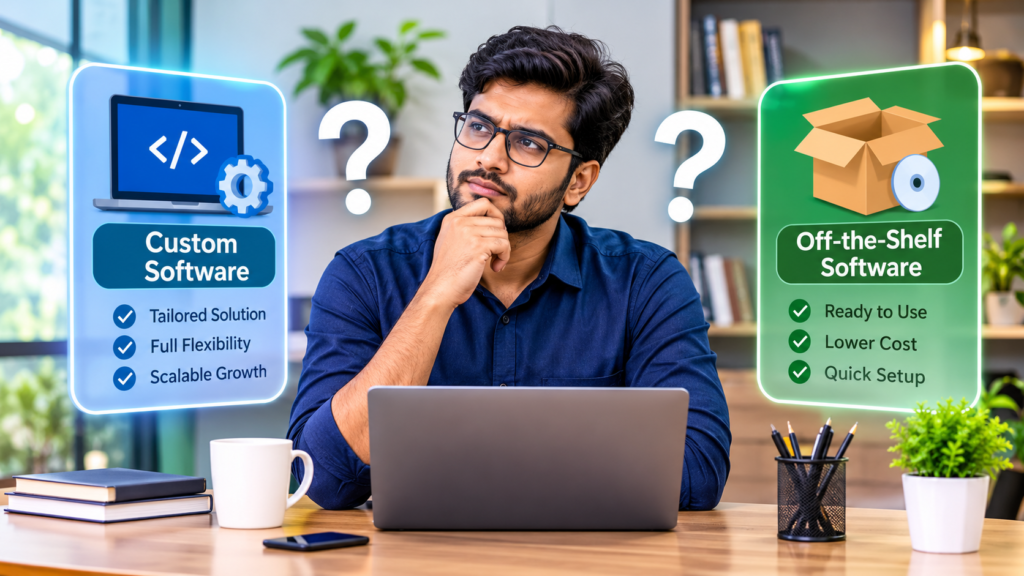
Custom software is developed around a specific organization, while off-the-shelf software provides standard functionality for a wider market.
Here is a practical comparison.
| Comparison Factor | Custom Software | Off-the-Shelf Software |
| Development | Built for specific requirements | Already developed |
| Initial Cost | Usually higher | Usually lower |
| Implementation | Requires development time | Often available immediately |
| Customization | Extensive flexibility | Limited to available options |
| Scalability | Can be designed around growth plans | Depends on provider and plan |
| Ownership | Depends on the development agreement | Usually licensed or subscription-based |
| Maintenance | Requires an agreed maintenance arrangement | Generally handled by the provider |
| Integration | Can be built around business systems | Depends on supported integrations |
| Security | Depends on development and security practices | Depends on the provider’s security practices |
| User Experience | Designed around specific workflows | Designed for a wider audience |
| Long-Term Cost | Depends on development and maintenance | Includes recurring license or subscription fees |
| Vendor Dependency | Depends on architecture and documentation | Often tied to the software provider |
Neither option is automatically better. The right choice depends on your business size, budget, operational complexity, and future plans.
Advantages of Custom Software for Growing Businesses
Custom software becomes particularly valuable when standard applications cannot support important business processes.
For companies planning long-term growth, a purpose-built application can offer several benefits.
1. Designed Around Your Business Requirements
Every business has its own operating procedures.
A wholesale distributor, hospital, manufacturing company, and digital marketing agency may all need management software, but their requirements are completely different.
Custom software allows developers to build features around actual business activities.
For example, a distribution company operating across Dhaka, Chattogram, and Sylhet may require:
- Multiple warehouse management.
- Territory-based sales reporting.
- Distributor account management.
- Delivery tracking.
- Product stock transfers.
- Sales commission calculations.
Rather than using multiple disconnected applications, the company can operate through one integrated system.
This reduces unnecessary manual work and makes information easier to manage.
2. Greater Flexibility and Customization
Business requirements change over time.
A startup may initially need customer registration, order management, and payment tracking. After expanding, it may require employee management, automated notifications, advanced reporting, and third-party integrations.
With custom software, new functionality can be developed according to changing requirements.
Businesses can also decide how users interact with the application, what information they see, and which actions they are permitted to perform.
This level of flexibility is particularly useful for organizations with specialized operational processes.
3. Better Integration With Existing Systems
Many businesses use separate applications for accounting, inventory, sales, customer communication, and employee management.
When these systems do not communicate properly, employees often have to enter the same information multiple times.
Custom software can connect different business applications through APIs and other integration methods.
For example, an eCommerce company could connect its website with:
- Inventory management software.
- Accounting applications.
- Payment gateways.
- Courier services.
- Customer relationship management systems.
- Email and SMS notification platforms.
The result is a more connected business environment.
However, successful integration depends on the availability, security, and technical capabilities of the systems involved.
4. Better Support for Business Growth
A business application should not become an obstacle when a company expands.
Custom software can be designed to accommodate increasing users, transactions, products, branches, and operational requirements.
For example, a retail company might begin with one physical store and later expand into several locations.
Its software may eventually need centralised inventory management, branch-level reporting, employee permissions, and consolidated financial information.
A properly planned custom application can support these requirements through an expandable architecture.
Scalability is not automatic, though. Developers must consider infrastructure, database performance, application architecture, and future capacity during the planning stage.
5. Greater Control Over Features and Data
With custom software, businesses can have more control over how their applications work and how their information is managed.
Depending on the development agreement, the business may own the source code and associated intellectual property.
This can provide greater independence when planning future upgrades or changing development partners.
However, software ownership should always be clearly defined in the contract.
Businesses should confirm:
- Who owns the source code?
- Who controls the hosting environment?
- Who has database access?
- Can another developer maintain the application?
- Are technical documents included?
- What happens if the development partnership ends?
These questions are important when investing in a business-critical application.
Advantages of Off-the-Shelf Software
Ready-made applications remain a practical choice for many businesses, particularly when their requirements are straightforward.
1. Lower Initial Investment
One of the biggest advantages of off-the-shelf software is its relatively low starting cost.
Businesses do not need to finance an entire development project before using the application.
Many providers offer free plans, monthly subscriptions, annual licences, or different pricing packages.
This makes ready-made software attractive to startups, freelancers, small retailers, and businesses with limited technology budgets.
2. Faster Implementation
A ready-made application can often be installed, configured, and used within a short period.
For example, a newly established digital marketing agency may use an existing project management application to assign tasks, monitor deadlines, and communicate with team members.
There is no need to wait for a lengthy development process.
This is particularly beneficial when a business needs an immediate solution to a common operational problem.
3. Regular Updates and Improvements
Established software providers generally release updates to improve performance, introduce features, address bugs, and fix security vulnerabilities.
Businesses using subscription-based applications can often receive these improvements without managing the entire development process themselves.
However, users should still review update policies, compatibility requirements, and subscription conditions.
4. Technical Support and Documentation
Many established software providers offer customer support, tutorials, documentation, knowledge bases, and user communities.
These resources can help employees learn the application and resolve common problems.
Support availability depends on the provider and subscription plan.
5. Suitable for Standard Business Activities
Not every company needs a fully customised application.
Businesses often have common requirements such as:
- Email communication.
- Document management.
- Basic accounting.
- Online meetings.
- Social media scheduling.
- Simple project management.
- Standard customer management.
Off-the-shelf software can handle these activities effectively without unnecessary development expenses.
Disadvantages of Custom Software
Although custom applications offer flexibility, they also involve challenges that business owners should understand.
Higher Initial Development Cost
Developing software from the beginning requires planning, design, programming, testing, deployment, and documentation.
The total investment depends on the project’s complexity, number of features, integrations, technology stack, and development team.
A simple business application may require a relatively modest budget, while a complex enterprise platform can require a substantial investment.
Businesses should evaluate the expected operational benefits rather than comparing development costs alone.
Longer Development Time
Custom software cannot usually be deployed immediately.
Developers need time to understand requirements, create the application, test functionality, resolve issues, and prepare the production environment.
Unclear requirements and frequent changes can increase the timeline.
A properly managed development process helps prevent unnecessary delays.
Ongoing Maintenance Requirements
Custom software requires continuous attention after launch.
Maintenance may involve:
- Security updates.
- Bug fixes.
- Database optimisation.
- Server monitoring.
- Backup management.
- Performance improvements.
- Compatibility updates.
- New feature development.
Businesses should plan for these responsibilities before starting the project.
Dependence on Technical Expertise
A custom application needs developers or a capable technical partner for updates and troubleshooting.
If the original development team becomes unavailable and the project has poor documentation, maintaining the system can become difficult.
This is why source code access, technical documentation, and proper handover procedures matter.
Disadvantages of Off-the-Shelf Software
Ready-made applications are convenient, but they may not always match the operational needs of a growing organisation.
Limited Customisation
Standard applications are designed for a broad customer base.
As a result, some specialised business requirements may not be supported.
A manufacturing company might need a unique production approval process, while its selected management software only supports standard workflows.
Employees may have to create manual workarounds or maintain additional spreadsheets.
Recurring Subscription Costs
Many off-the-shelf applications operate through monthly or annual subscriptions.
The initial cost may appear affordable, but expenses can increase as the business adds employees, storage, advanced features, or additional services.
Business owners should calculate the total subscription cost over several years.
Vendor Dependency
When a business depends heavily on a third-party application, it also depends on the provider’s pricing, policies, availability, and development decisions.
A provider may discontinue a feature, increase subscription prices, change service conditions, or discontinue the product entirely.
Moving to another application may also require data migration, employee training, and operational adjustments.
Integration Limitations
Some applications support only selected integrations.
A company using several specialised business systems may discover that its preferred software cannot exchange information with an important existing application.
Third-party connectors may solve the problem, but they can introduce additional costs and technical complexity.
Limited Control Over Data and Infrastructure
Depending on the service agreement, customers may have limited control over hosting, database infrastructure, backup arrangements, and data retention.
Before adopting a cloud-based application, businesses should review the provider’s data policies, export options, security arrangements, and service terms.
Custom Software vs Off the Shelf: Which Is More Cost-Effective?
Cost is often the deciding factor for Bangladeshi business owners.
However, comparing only the initial purchase price can lead to poor decisions.
A better approach is to calculate the total cost of ownership.
Total cost of ownership includes all expenses associated with purchasing, implementing, operating, maintaining, and eventually replacing a software solution.
Understanding the Cost of Custom Software
Custom development expenses may include:
- Business requirement analysis.
- UI and UX design.
- Frontend development.
- Backend development.
- Database development.
- API integrations.
- Testing and quality assurance.
- Hosting and deployment.
- Security implementation.
- Maintenance and technical support.
The exact budget depends on the scope and complexity of the project.
For example, a basic inventory management application requires fewer resources than a complete enterprise resource planning platform connecting several departments.
Understanding the Cost of Off-the-Shelf Software
Ready-made software expenses may include:
- Initial setup fees.
- Monthly or annual subscriptions.
- Additional user licences.
- Premium features.
- Third-party integrations.
- Data storage.
- Training.
- Migration costs.
- Advanced support packages.
A low monthly subscription can become expensive when dozens or hundreds of employees need access.
A Practical Cost Comparison
Consider a growing Bangladeshi company that needs inventory, sales, customer management, and reporting features.
It has two possible approaches.
Option A: Off-the-shelf software
The company subscribes to several applications to manage different business activities.
The initial investment is low, but it must continue paying for multiple subscriptions. Employees may also need to transfer information between systems.
Option B: Custom software
The company invests in an integrated business application.
The initial development cost is higher, but the system can connect important business processes and reduce unnecessary manual operations.
Neither approach guarantees lower lifetime expenses.
The better option depends on the number of users, subscription costs, maintenance requirements, operational savings, and expected business growth.
When Should a Business Choose Custom Software?
Custom software is generally worth considering when standard applications cannot properly support essential business activities.
Here are some situations where a purpose-built solution may be the better investment.
Your Business Has Unique Operational Requirements
If your company follows specialised workflows that standard applications cannot support, custom development can provide a more suitable solution.
Examples include:
- Garment manufacturing management.
- Distribution and supply chain management.
- Hospital management systems.
- Educational institution management.
- Transport and logistics management.
- Financial reporting platforms.
- Large-scale inventory management.
Your Business Uses Multiple Disconnected Applications
If employees repeatedly enter the same information into different systems, an integrated application may improve operational efficiency.
A custom platform can bring important business functions together and reduce information gaps.
You Need Advanced Automation
Businesses with repetitive and time-consuming processes can benefit from purpose-built automation.
For example, a distribution company may want automated order allocation, stock alerts, invoice generation, and delivery status updates.
These features can reduce manual work and improve consistency.
You Have Long-Term Expansion Plans
Companies planning to add branches, employees, products, warehouses, or new service categories should consider how their software will support future requirements.
Custom software can be developed with these expansion plans in mind.
You Need More Control Over Your Technology
Businesses that depend on specialised software for their core operations may prefer greater control over application features, infrastructure, data, and development priorities.
In these situations, custom development may provide strategic value.
When Is Off-the-Shelf Software the Better Choice?
Custom development is not necessary for every business.
Ready-made software is often the smarter option when requirements are simple and well supported by existing applications.
Consider off-the-shelf software if:
- You are running a small business with limited operational requirements.
- You need an application immediately.
- Your budget cannot support custom development.
- Your business processes follow common industry practices.
- You need standard accounting or office productivity tools.
- You want to test a business idea before making a larger technology investment.
- You do not require specialised integrations.
For example, a small consultancy in Dhaka may only need professional email, document management, accounting, and project tracking.
Purchasing or subscribing to established applications would probably be more practical than developing separate systems for every activity.
A Third Option: Combining Custom and Off-the-Shelf Software
Business owners sometimes assume they must choose only one approach.
That is not always necessary.
A hybrid software strategy combines ready-made applications with custom-built systems.
This can be an effective approach for businesses that need specialised functionality without rebuilding every standard business tool.
For example, a Bangladeshi eCommerce company could use:
- An existing accounting application.
- A third-party payment gateway.
- A standard email marketing platform.
- Custom inventory management software.
- A custom order processing application.
- A dedicated customer management dashboard.
The custom application can connect these services through available APIs.
This approach allows the company to retain reliable standard tools while developing specialised functionality where it matters most.
It can also reduce development costs because the business does not need to recreate features that already work well in established applications.
However, integration planning is essential. Businesses should consider API limitations, data synchronisation, access permissions, service availability, and security.
Important Factors to Consider Before Making a Decision
Selecting business software requires more than comparing features and prices.
Before committing to either solution, evaluate the following factors.
1. Identify Your Actual Business Problems
Start by identifying the problems you want the software to solve.
Do not begin by collecting a long list of features.
Ask practical questions:
- Which business activities consume the most employee time?
- Where do errors frequently occur?
- Which processes depend on spreadsheets?
- Which departments struggle to share information?
- What information do managers need but cannot access easily?
- Which activities should be automated?
These questions will help you understand whether an existing application can solve the problem or whether custom development is necessary.
2. Calculate Your Budget
Consider both the initial investment and ongoing expenses.
For custom software, include development, hosting, maintenance, and future improvements.
For ready-made applications, calculate subscriptions, licences, additional users, integrations, and potential migration costs.
A realistic budget should also include employee training and implementation expenses.
3. Evaluate Scalability
Think about where your business may be in the next three to five years.
Will you add employees, branches, warehouses, or new services?
Will your transaction volume increase significantly?
Choose a solution that can accommodate realistic growth without creating unnecessary technical or financial difficulties.
4. Review Security and Data Management
Business software often stores confidential customer information, employee records, financial details, and operational data.
Review:
- User authentication.
- Role-based access control.
- Data encryption.
- Backup procedures.
- Security updates.
- Activity monitoring.
- Data export options.
- Disaster recovery arrangements.
For businesses operating in Bangladesh, it is also important to review applicable legal and regulatory obligations concerning personal and business information.
5. Check Integration Requirements
List the applications and services your business already uses.
Identify whether the new system needs to communicate with accounting software, payment gateways, courier services, websites, mobile applications, or external databases.
Integration requirements can significantly affect the final project budget.
6. Consider Employee Experience
Software should make employees’ work easier rather than introduce unnecessary complexity.
An application with hundreds of features is not useful if employees struggle to operate it.
Consider the experience of the actual users, provide appropriate training, and involve key employees during the planning and testing stages.
How to Choose the Right Custom Software Development Company in Bangladesh
If custom software appears to be the right option, selecting a reliable development partner becomes your next important decision.
The quality of the final application depends not only on programming but also on requirement analysis, project management, security practices, testing, and long-term support.
Here are some important points to evaluate.
Review the Company’s Experience
Look for a development company with relevant industry experience.
Ask whether it has worked on projects similar to yours and whether it can demonstrate completed applications.
Review its portfolio, client feedback, and technical capabilities.
Understand Its Development Process
A professional development partner should have a clear project workflow.
A typical process includes:
- Initial consultation and requirement gathering.
- Business analysis and project planning.
- UI and UX design.
- Software architecture and technology selection.
- Development and integration.
- Testing and quality assurance.
- Deployment and launch.
- Training, maintenance, and support.
You should understand what will be delivered at each stage.
Ask About Security and Quality Assurance
Security should be considered from the beginning, not added as an afterthought.
Ask how the development team handles authentication, data protection, secure coding, backups, testing, and vulnerability management.
Also confirm whether the application will be tested before deployment.
Confirm Source Code and Ownership
Before signing a contract, clarify intellectual property rights.
The agreement should explain who owns the source code, database structure, designs, documentation, and other project deliverables.
Also discuss access to hosting accounts and deployment environments.
Evaluate Communication and Support
Software development is a collaborative process.
Choose a company that communicates clearly, provides progress updates, documents important decisions, and explains technical matters in understandable language.
Ask what happens after the application launches.
Reliable post-launch support is particularly important when software becomes part of daily business operations.
Why Businesses Choose Creative Tech Park for Software Development
Selecting a software development partner is an important business decision. Companies need a team that understands both technology and the practical challenges of running an organisation.
Creative Tech Park is a Dhaka-based web design, software development, and IT services agency operating since 2012.
With 26 in-house staff, 5,000+ clients, and 7,000+ completed projects, the company brings experience across a wide range of digital and technology requirements.
Its services are relevant to businesses looking for professional digital solutions, whether they are launching a new project or improving an existing business operation.
Business-Focused Software Solutions
Creative Tech Park focuses on understanding business requirements before moving into development.
This approach helps identify the features that matter most, avoid unnecessary complexity, and create a clearer development plan.
Web Design and Development Experience
A professional website is an important part of modern business operations.
Companies may need corporate websites, eCommerce platforms, service websites, or custom web applications to improve their digital presence and customer experience.
Creative Tech Park provides web design and development services to businesses looking for practical online solutions.
Support for Different Business Requirements
A startup does not have the same technology requirements as an established enterprise.
Creative Tech Park works with a broad client base, making it relevant to businesses at different stages of development.
Whether a company needs a website, a digital platform, or a specialised software solution, understanding its requirements is the first step toward selecting an appropriate technology.
Businesses can explore the company’s services and discuss their project requirements before making an investment.
Frequently Asked Questions
1. What Is the Main Difference Between Custom Software and Off-the-Shelf Software?
Custom software is developed specifically for an organisation’s requirements, while off-the-shelf software is a ready-made application designed for a wider audience.
Custom applications offer greater flexibility, whereas ready-made applications generally provide faster implementation and lower initial costs.
2. Is Custom Software Better Than Off-the-Shelf Software?
Not necessarily.
Custom software is often better for businesses with specialised workflows, integration requirements, or long-term expansion plans.
Off-the-shelf software is usually more practical for standard business activities that existing applications already support.
3. Is Custom Software More Expensive?
Custom software generally requires a higher initial investment because it involves planning, design, development, and testing.
However, its long-term cost-effectiveness depends on maintenance expenses, operational savings, subscription alternatives, and business requirements.
4. How Long Does Custom Software Development Take?
The timeline depends on project complexity, features, integrations, testing requirements, and development resources.
A relatively simple application may take a few weeks or months, while a complex enterprise system may require considerably longer.
A development company should provide a realistic timeline after understanding the project scope.
5. Can Small Businesses Benefit From Custom Software?
Yes. Small businesses can benefit from custom software when they have specific operational requirements that standard applications cannot adequately support.
However, a small company should avoid unnecessary development expenses and consider existing solutions first.
6. Can Custom Software Integrate With Existing Applications?
Yes. Custom applications can often connect with existing systems through APIs and other integration technologies.
The feasibility depends on the technical capabilities and integration options provided by the existing applications.
7. Is Off-the-Shelf Software Secure?
Many established software providers invest in security measures, infrastructure, and regular updates.
However, security varies between providers. Businesses should review authentication, encryption, backup policies, data management, and compliance arrangements before choosing a platform.
8. Can a Business Start With Off-the-Shelf Software and Move to Custom Software Later?
Yes. Many businesses begin with ready-made applications and move to custom systems when their requirements become more complex.
However, data migration, integration, and employee training should be planned carefully to avoid operational disruption.
9. What Should I Ask a Software Development Company Before Hiring It?
Ask about its experience, development process, project timeline, pricing structure, security practices, source code ownership, documentation, maintenance, and post-launch support.
A professional development partner should provide clear answers before the project begins.
10. Which Software Solution Is Best for a Growing Business in Bangladesh?
The best solution depends on the company’s operational requirements, budget, industry, and expansion plans.
Businesses with standard requirements can benefit from ready-made applications. Companies with specialised workflows or complex integration needs may benefit more from custom software.
Final Thoughts: Make the Decision Based on Your Business Needs
Choosing between custom software and off-the-shelf software is not simply a technology decision. It is an investment decision that can influence business efficiency, operating expenses, customer experience, and future growth.
If your business needs a quick, affordable solution for common activities, off-the-shelf software may be the right starting point.
If your organisation has specialised processes, complex integrations, or requirements that existing applications cannot adequately support, custom software deserves serious consideration.
You can also combine both approaches to achieve a practical balance between flexibility and cost.
Before making your final decision, identify your business challenges, calculate the total cost of ownership, evaluate future requirements, and consult an experienced development team.
Creative Tech Park, with its experience in the Bangladeshi technology industry since 2012, can help businesses explore their digital requirements and identify suitable web and software development solutions.
The right software is not necessarily the one with the most features or the lowest price. It is the one that solves your business problems, supports your team, and makes your next stage of growth easier to manage.
- Business Automation
- Business Software
- Business Technology
- Custom Software
- Custom Software Development
- Custom Software vs Off the Shelf
- Digital Transformation
- ERP Software
- IT Solutions Bangladesh
- Off-the-Shelf Software
- Software Company in Dhaka
- Software Comparison
- Software Development
- Software Solutions

Written by
Abdullah Al Masum
Part of the Creative Tech Park team in Dhaka, Bangladesh, building websites, apps and business software since 2012.