

In this article
- Industry Playbooks: Website and Software Lessons by Business Type in Bangladesh
- Why Every Industry Needs a Different Website Strategy
- 12 Industry-Specific Website and Software Solutions for Bangladeshi Businesses
- 1. Ecommerce and Retail Businesses
- 2. Healthcare, Hospitals, and Diagnostic Centers
- 3. Educational Institutions and Training Centers
- 4. Real Estate and Property Development Companies
- 5. Manufacturing and Industrial Companies
- 6. Restaurants, Cafes, and Food Businesses
- 7. Travel Agencies and Tourism Companies
- 8. Banking, Financial Services, and Insurance
- 9. Professional Services and Consulting Firms
- 10. Logistics, Courier, and Transportation Companies
- 11. Construction and Engineering Companies
- 12. Fashion, Garments, and Textile Businesses
- Website vs Custom Software: What Does Your Industry Actually Need?
- 7 Common Website and Software Mistakes Businesses Should Avoid
- How to Choose the Right Website and Software Development Partner in Bangladesh
- Why Businesses Choose Creative Tech Park for Digital Solutions
- Frequently Asked Questions About Industry Website Solutions in Bangladesh
- 1. What are industry-specific website solutions?
- 2. Why should businesses choose industry-specific website development?
- 3. Which industries need custom website development in Bangladesh?
- 4. What is the difference between website development and software development?
- 5. How much does industry-specific website development cost in Bangladesh?
- 6. Should a small business invest in custom software?
- 7. Can one website serve multiple business locations?
- 8. Is SEO important for industry-specific websites?
- 9. How long does it take to develop an industry-specific website?
- 10. How do I choose the right IT company in Dhaka?
- Final Thoughts
Industry Playbooks: Website and Software Lessons by Business Type in Bangladesh
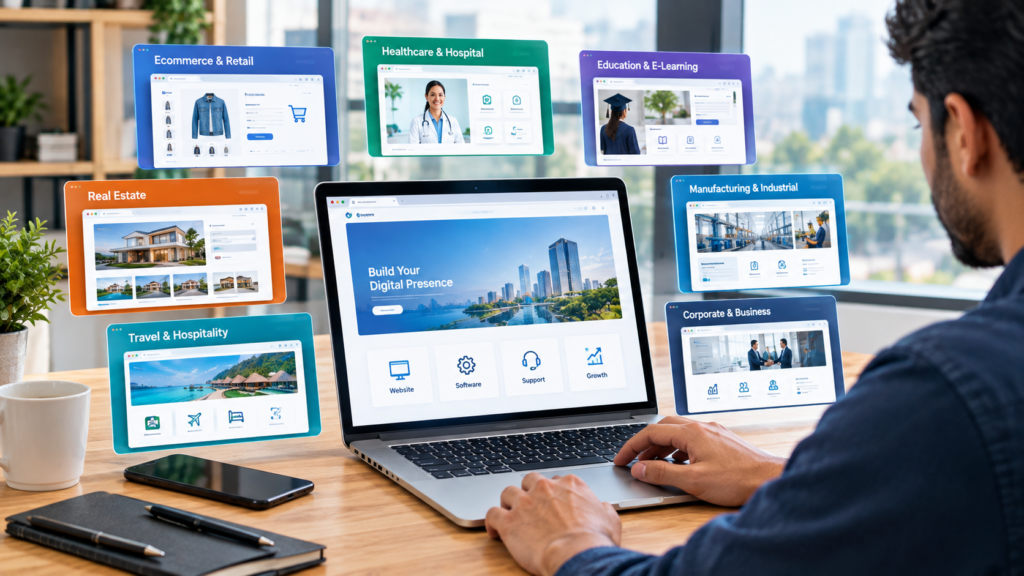
A website that works perfectly for an ecommerce business may not be the right solution for a hospital, manufacturing company, educational institution, or real estate agency. Every industry has different customers, operational requirements, marketing priorities, and technology challenges. Choosing the right website and software solution requires understanding those differences before starting development.
In Bangladesh, businesses across almost every sector are investing in digital platforms to improve customer communication, manage operations, generate leads, and reach new markets. However, many business owners make the mistake of choosing a website based only on appearance or initial development cost. They often overlook the functionality their industry actually needs.
For example, an online clothing store needs product variations, shopping carts, payment integration, and delivery management. A hospital needs appointment scheduling, doctor profiles, and reliable patient information management. A manufacturing company may need product catalogs, quotation requests, distributor information, and business inquiry management.
This is why industry website solutions in Bangladesh are an important consideration for businesses planning their digital transformation. The right approach is not to build the same website for every company. It is to select technology according to the way each business operates.
This industry playbook explores website and software requirements across major business sectors in Bangladesh. It explains which features matter, what mistakes to avoid, and how businesses can choose technology that supports their long-term goals.
Creative Tech Park, a Dhaka-based web design, software development, and IT services agency operating since 2012, works with businesses that need practical digital solutions. With 26 in-house professionals, more than 5,000 clients, and over 7,000 completed projects, the company understands the importance of matching technology with business requirements.
Why Every Industry Needs a Different Website Strategy
A website should support the actual activities of a business rather than simply provide an online address.
Different industries attract different audiences and follow different customer journeys. Some businesses need online transactions, while others depend on inquiries, appointments, quotations, or long-term customer relationships.
Consider these examples:
- An ecommerce company wants visitors to purchase products.
- A hospital wants patients to find doctors and book appointments.
- A real estate company wants buyers to explore properties and contact sales teams.
- A manufacturing company wants distributors and corporate buyers to request quotations.
- An educational institution wants students to explore courses and complete admission enquiries.
- A travel agency wants customers to compare packages and request bookings.
These differences affect website structure, software selection, user experience, and development costs.
A properly planned industry-specific website can help businesses:
- Reach their target customers.
- Improve customer communication.
- Generate qualified inquiries.
- Reduce repetitive administrative work.
- Present products and services professionally.
- Manage business information more effectively.
- Support marketing and search engine visibility.
- Prepare for future expansion.
The first step is understanding what customers expect when they visit your website.
12 Industry-Specific Website and Software Solutions for Bangladeshi Businesses
The following industry playbooks explain the major website requirements and useful software features for different types of businesses operating in Bangladesh.
1. Ecommerce and Retail Businesses
E-commerce and retail businesses depend on product discovery, customer confidence, convenient purchasing, and reliable order fulfillment.
A customer visiting an online store should be able to find products, compare options, understand prices, select payment methods, and complete an order without unnecessary difficulties.
Bangladeshi online stores also need to consider mobile shopping, local payment preferences, and delivery services.
- Mobile-friendly website design.
- Product categories and subcategories.
- Advanced product search and filtering.
- Detailed product pages.
- Shopping cart and wishlist.
- Secure checkout.
- Payment gateway integration.
- Cash-on-delivery options.
- Order tracking.
- Customer reviews and ratings.
- Coupon and discount management.
- Inventory management.
As a retail business grows, managing products and orders manually becomes difficult.
An ecommerce management system can help businesses control inventory, process orders, monitor sales, and manage customer information from a centralized dashboard.
Businesses with physical stores may also benefit from Point of Sale (POS) integration. This can help synchronize online and offline sales when supported by the selected platform.
Practical example: A clothing retailer selling products through a website and physical showroom can use centralized inventory management to reduce stock discrepancies and provide customers with more accurate availability information.
2. Healthcare, Hospitals, and Diagnostic Centers
Healthcare websites serve patients who need accurate information and convenient access to medical services.
Patients may visit a hospital website to find doctors, check available departments, understand diagnostic services, or request appointments.
Trust, accessibility, privacy, and accurate information are particularly important in this sector.
- Hospital and clinic information.
- Doctor profiles and qualifications.
- Department and service listings.
- Appointment booking.
- Diagnostic test information.
- Branch and location details.
- Emergency contact information.
- Patient inquiry forms.
- Frequently Asked Questions.
- Mobile-friendly navigation.
Hospitals and diagnostic centers may require specialized software to manage their daily operations.
Useful systems include:
- Hospital Management Systems (HMS).
- Patient Management Systems.
- Appointment Management Software.
- Laboratory Information Management Systems (LIMS).
- Billing and reporting systems.
- Doctor scheduling software.
Healthcare businesses must handle patient information responsibly. Apply appropriate access controls, secure storage, encryption, audit logging, and privacy safeguards.
Practical example: A diagnostic center with multiple branches can use an appointment management system to organize bookings, reduce scheduling conflicts, and help staff manage patient inquiries.
3. Educational Institutions and Training Centers
Schools, colleges, universities, coaching centers, and professional training institutes need websites that communicate educational information clearly.
Students and parents often want to check courses, admission requirements, tuition fees, class schedules, faculty information, and examination details.
An organized website can reduce administrative inquiries and make important information easier to access.
- Institution introduction.
- Course and program listings.
- Admission information.
- Online application forms.
- Faculty profiles.
- Academic calendar.
- Notice board.
- Examination schedules.
- Event announcements.
- Contact and location information.
Educational institutions can benefit from dedicated management platforms.
Consider:
- Learning Management Systems (LMS).
- Student Information Systems (SIS).
- School Management Software.
- Online examination systems.
- Attendance management.
- Fee collection systems.
- Parent communication portals.
An LMS is particularly useful for institutions offering online or blended learning.
Practical example: A private training institute in Dhaka can publish its courses online, accept admission inquiries, organize student records, and provide learning materials through a centralized digital platform.
4. Real Estate and Property Development Companies
Real estate customers often research multiple properties before contacting a developer or agent.
They want to understand property locations, prices, sizes, facilities, project progress, and availability.
A real estate website should present this information clearly and make it easy for potential buyers to request further details.
- Property listing pages.
- Advanced property search.
- Location and area filters.
- Property photographs.
- Floor plans.
- Property specifications.
- Project details.
- Availability information.
- Enquiry forms.
- Site visit requests.
- Map integration.
Real estate businesses can improve their sales operations through Customer Relationship Management (CRM) software.
A CRM system can help manage:
- Potential buyers.
- Property enquiries.
- Sales representatives.
- Follow-up activities.
- Customer communication.
- Booking information.
- Sales pipeline reports.
Practical example: A property developer working on several apartment projects can organize all project inquiries in a CRM system and assign follow-up tasks to the appropriate sales representatives.
5. Manufacturing and Industrial Companies
Manufacturing companies often sell to distributors, wholesalers, retailers, and corporate buyers rather than directly to individual consumers.
Their websites should communicate production capabilities, product specifications, certifications, business experience, and supply capacity.
For export-oriented businesses, professional presentation and clear international enquiry channels are especially important.
- Company profile.
- Product catalogue.
- Manufacturing capabilities.
- Product specifications.
- Factory and facility information.
- Quality certifications.
- Industry-specific solutions.
- Downloadable product brochures.
- Request for Quotation (RFQ) forms.
- Distributor inquiries.
- Export and international contact information.
Depending on the size and complexity of the operation, manufacturing companies may benefit from:
- Enterprise Resource Planning (ERP).
- Inventory Management Software.
- Production Planning Systems.
- Supply Chain Management Software.
- Warehouse Management Systems.
- CRM platforms.
- Quality Management Systems.
These systems can help coordinate different business activities and reduce dependence on disconnected spreadsheets.
Practical example: A garment manufacturer can use a professional website to display its production capabilities and certifications while using a CRM system to organize inquiries from international buyers.
6. Restaurants, Cafes, and Food Businesses
Customers visiting a restaurant website usually want practical information quickly.
They may want to see the menu, check prices, find the restaurant location, make reservations, or place an order.
A restaurant website should make these activities simple, particularly on mobile devices.
- Digital food menu.
- Food photographs.
- Pricing information.
- Restaurant location.
- Opening hours.
- Table reservation.
- Online ordering.
- Delivery information.
- Contact details.
- Customer reviews.
- Promotional offers.
Restaurants with higher order volumes may benefit from:
- Restaurant Management Software.
- POS Systems.
- Kitchen Order Management.
- Online Ordering Systems.
- Table Reservation Software.
- Delivery Management.
- Inventory and Billing Software.
A restaurant operating multiple branches may also need centralized menu, sales, and inventory management.
Practical example: A restaurant in Dhaka can use its website to display updated menus, accept reservation requests, and direct customers to its available online ordering channels.
7. Travel Agencies and Tourism Companies
Travel customers often compare destinations, tour packages, prices, accommodation options, and travel arrangements before making a decision.
A travel website should provide detailed package information and clear inquiry or booking options.
Businesses serving international customers may also need multilingual content and international payment support.
- Tour package listings.
- Destination pages.
- Travel itineraries.
- Package pricing.
- Hotel and accommodation details.
- Travel inquiry forms.
- Booking requests.
- Customer testimonials.
- Travel guides.
- Contact and support information.
Travel businesses may benefit from:
- Travel Management Software.
- Booking Management Systems.
- CRM Software.
- Tour Scheduling Systems.
- Payment Integration.
- Customer Communication Automation.
For businesses offering complex travel services, API integration with relevant booking providers may also be useful.
Practical example: A tour operator offering trips to Cox’s Bazar, Sylhet, and Bandarban can organize packages on its website and manage customer inquiries through a centralized booking system.
8. Banking, Financial Services, and Insurance
Financial organizations need websites that communicate services accurately and provide secure access to relevant information.
Customers may visit these websites to explore financial products, understand service requirements, find branches, or submit inquiries.
Security, privacy, regulatory requirements, and accessibility should receive particular attention.
- Financial product information.
- Service descriptions.
- Branch and ATM locations.
- Online inquiry forms.
- Customer support information.
- Important notices.
- Downloadable forms.
- Frequently Asked Questions.
- Secure customer login, where applicable.
- Privacy and legal information.
Depending on the organization and its regulatory requirements, useful systems may include:
- Customer Relationship Management.
- Document Management Systems.
- Workflow Automation.
- Secure Customer Portals.
- Reporting and Analytics.
- Enterprise Resource Planning.
- Identity and Access Management.
Financial platforms handling transactions or sensitive customer information require specialized security reviews and appropriate compliance controls.
Practical example: An insurance company can use its website to explain different insurance products, collect customer inquiries, and provide a secure portal for authorized policy-related activities.
9. Professional Services and Consulting Firms
Consulting firms, law firms, accounting agencies, IT companies, and other professional service providers often depend on trust and professional credibility.
Potential clients want to understand the company’s expertise, services, experience, and approach before requesting a consultation.
A professional website should communicate value without overwhelming visitors with unnecessary information.
- Professional homepage.
- Service descriptions.
- Company profile.
- Team and expert profiles.
- Case studies.
- Client testimonials.
- Blog and insights section.
- Appointment booking.
- Contact forms.
- Location and business information.
Professional service providers may benefit from:
- CRM Software.
- Project Management Systems.
- Appointment Scheduling.
- Document Management.
- Client Portals.
- Billing and Invoicing.
- Workflow Automation.
Practical example: A Dhaka-based IT consultancy can use its website to present service packages, publish technical articles, display selected case studies, and collect qualified business inquiries.
10. Logistics, Courier, and Transportation Companies
Logistics businesses depend on accurate shipment information, efficient communication, and operational coordination.
Customers expect to know where their parcels are and when they may arrive.
A website should provide clear service information and convenient shipment tracking.
- Service listings.
- Parcel tracking.
- Delivery coverage information.
- Branch locations.
- Pricing information.
- Business account inquiries.
- Delivery instructions.
- Contact information.
- Customer support.
- Shipment status notifications.
Consider:
- Courier Management Software.
- Shipment Tracking Systems.
- Fleet Management Software.
- Route Planning.
- Warehouse Management.
- Delivery Management.
- Automated SMS Notifications.
API integrations can connect a customer-facing website with internal shipment systems.
Practical example: A courier company serving multiple districts can provide a parcel tracking page where customers enter a tracking number to check shipment progress.
11. Construction and Engineering Companies
Construction and engineering companies often compete for large projects and corporate contracts.
Their websites should demonstrate technical capability, previous work, professional experience, and service coverage.
Potential clients may include developers, government organizations, industrial businesses, and private property owners.
- Company introduction.
- Construction services.
- Completed project portfolio.
- Ongoing project information.
- Project photographs.
- Engineering capabilities.
- Certifications and qualifications.
- Equipment and machinery details.
- Tender and quotation inquiries.
- Contact information.
Growing construction companies may require:
- Project Management Software.
- Document Management Systems.
- Resource Planning.
- Equipment Management.
- Employee Management.
- Accounting Software.
- ERP Integration.
These systems can help coordinate projects, resources, documentation, and business operations.
Practical example: An engineering company can use its website to showcase completed industrial projects while using project management software to coordinate internal teams and project deadlines.
12. Fashion, Garments, and Textile Businesses
Bangladesh has a significant garments and textile industry, serving both domestic and international markets.
Fashion brands and manufacturers have different website requirements depending on whether they sell directly to consumers or work with wholesale and export buyers.
A retail fashion website should focus on shopping convenience, while an export-oriented manufacturer should highlight production capacity and business credentials.
- Product and collection galleries.
- Size and color variations.
- Product photography.
- Fabric information.
- Shopping cart for retail stores.
- Wholesale inquiry forms.
- Product catalogues.
- Factory information.
- Sustainability and compliance information, where verified.
- International contact options.
Depending on the business model, useful systems include:
- Inventory Management.
- ERP Software.
- Order Management.
- Production Planning.
- Supply Chain Management.
- CRM.
- Retail POS Systems.
Practical example: A textile manufacturer can create a corporate website with downloadable product catalogues and wholesale inquiry forms, while a fashion retailer can use an ecommerce platform to sell collections directly to consumers.
Website vs Custom Software: What Does Your Industry Actually Need?
A website and a business software application solve different problems.
A website primarily communicates information, supports marketing, and helps customers interact with your business. Business software manages internal processes, data, and operational activities.
Some companies need only a professional website. Others require both a website and custom software.
| Business Requirement | Recommended Solution |
| Display products and services | Business website |
| Sell products online | Ecommerce website |
| Manage customer inquiries. | CRM software |
| Manage employees. | HR Management Software |
| Track stock and inventory. | Inventory Management System |
| Manage accounts and operations | ERP software |
| Organize student information. | Student Management System |
| Manage hospital activities. | Hospital Management System |
| Track deliveries. | Courier Management System |
| Manage internal projects. | Project Management Software |
When Should You Choose a Ready-Made Solution?
Ready-made software can be a practical choice when your business has standard requirements.
Consider it when:
- Your budget is limited.
- You need to launch quickly.
- Existing software covers your main workflows.
- You do not require extensive customization.
- The provider offers reliable updates and support.
However, check licensing costs, data ownership, integration options, and vendor dependency before making a decision.
When Is Custom Software Development Better?
Custom software may be appropriate when your business has unique processes that existing platforms cannot handle efficiently.
For example, a manufacturing company with specialized production workflows may require software designed around its own operational requirements.
Custom development may provide:
- Business-specific functionality.
- Flexible integrations.
- Custom reporting.
- Specialized user permissions.
- Greater control over workflows.
- A platform designed for future expansion.
The decision should be based on actual operational needs rather than assuming that custom development is always better.
7 Common Website and Software Mistakes Businesses Should Avoid
Even businesses with significant technology budgets can make poor digital investment decisions.
Here are seven mistakes worth avoiding.
1. Using the Same Website Structure for Every Industry
A hospital, ecommerce store, and manufacturing company have different audiences and objectives.
Their websites should reflect those differences.
2. Focusing Only on Visual Design
An attractive website is valuable, but it must also provide useful information, easy navigation, reliable functionality, and appropriate performance.
3. Ignoring Mobile Users
A website that performs poorly on smartphones can lose potential customers.
Always test the mobile experience before launch.
4. Choosing Software Without Understanding Business Processes
Purchasing software before identifying operational requirements can result in unnecessary features, additional costs, and poor adoption.
Map your workflows before selecting a solution.
5. Ignoring Website Security
Weak passwords, outdated software, and poor access management can expose business systems to unnecessary risks.
Include security in the initial development plan.
6. Neglecting SEO and Content
A website should be discoverable through search engines.
Use relevant service pages, industry-specific content, descriptive headings, optimized metadata, and clear internal navigation.
7. Forgetting Long-Term Maintenance
Websites and software applications require regular updates, backups, performance monitoring, and technical support.
Include maintenance costs in your technology budget.
How to Choose the Right Website and Software Development Partner in Bangladesh
Selecting a development agency is an important business decision.
The right partner should understand your industry, technical requirements, target customers, and long-term business objectives.
Before hiring an agency, consider the following factors.
1. Review Previous Projects
Check whether the agency has experience with projects similar to yours.
Look at website quality, usability, functionality, and technical implementation.
2. Understand Its Development Process
A professional development process should include:
- Requirement analysis.
- Project planning.
- Website structure and design.
- Development.
- Testing.
- Launch.
- Post-launch support.
Ask how changes, feedback, and project approvals will be managed.
3. Discuss Your Business Requirements
Do not begin with a list of design references alone.
Explain how your business operates, who your customers are, what problems you want to solve, and which activities need automation.
4. Check Technical Capabilities
Depending on your project, you may need expertise in:
- WordPress development.
- Custom website development.
- Ecommerce development.
- Laravel and PHP development.
- Database management.
- API integration.
- UI/UX design.
- SEO-friendly development.
- Website security.
Make sure the agency has the relevant capabilities for your project.
5. Clarify Maintenance and Support
Ask what happens after the website launches.
Understand the support period, maintenance arrangements, update responsibilities, hosting requirements, and additional service costs.
6. Compare Value Rather Than Price Alone
A low-cost proposal may exclude important features, testing, documentation, or ongoing support.
Compare the complete project scope before choosing a development partner.
Why Businesses Choose Creative Tech Park for Digital Solutions
Every industry has different technology requirements, and businesses need development partners who understand those differences.
Creative Tech Park is a web design, software development, and IT services agency based in Dhaka, Bangladesh. The company has been operating since 2012 and works with businesses looking for practical digital solutions.
Its business experience includes:
- Established: 2012.
- Location: Dhaka, Bangladesh.
- In-house professionals: 26.
- Clients served: 5,000+.
- Completed projects: 7,000+.
Creative Tech Park helps businesses explore digital solutions based on their goals, operational needs, and target audiences.
Depending on project requirements and available services, businesses may explore solutions such as:
- Corporate website development.
- Ecommerce website development.
- Custom website development.
- WordPress website development.
- Custom software development.
- Business management applications.
- Website redesign.
- Website maintenance.
- Digital solutions for business growth.
For example, a manufacturing company may need a professional corporate website with product catalogues and quotation forms. An ecommerce business may require a shopping platform with inventory and payment integration. A service-based company may need a website that generates inquiries and organizes customer information.
The development approach should be different for each project.
Creative Tech Park’s experience since 2012, supported by its in-house team and project history, provides a foundation for discussing business technology requirements and planning suitable solutions.
Looking for an industry-specific website or software solution in Bangladesh? Visit Creative Tech Park to explore its services and discuss your business requirements with its team.
Frequently Asked Questions About Industry Website Solutions in Bangladesh
1. What are industry-specific website solutions?
Industry-specific website solutions are websites designed around the needs of a particular business sector.
They include features, layouts, content structures, and integrations that support the way an industry operates.
For example, an ecommerce website needs shopping and payment functionality, while a hospital website may require doctor profiles and appointment management.
2. Why should businesses choose industry-specific website development?
Industry-specific development helps businesses provide relevant information and functionality to their target customers.
It also reduces unnecessary features and allows development teams to focus on the business’s actual requirements.
3. Which industries need custom website development in Bangladesh?
Almost every industry can benefit from professional website development.
Common examples include ecommerce, healthcare, education, manufacturing, real estate, construction, logistics, hospitality, financial services, and professional consulting.
The level of customization depends on business requirements.
4. What is the difference between website development and software development?
Website development focuses on creating websites for information, marketing, customer interaction, and online transactions.
Software development involves creating applications that manage business processes, information, workflows, and specialized operations.
Some businesses need both.
5. How much does industry-specific website development cost in Bangladesh?
The cost depends on website complexity, design, functionality, integrations, technology, and development time.
A basic corporate website generally requires a different investment from a custom ecommerce platform or enterprise application.
Request a project quotation based on a clearly defined scope.
6. Should a small business invest in custom software?
Not necessarily.
Small businesses should first identify their operational problems and check whether existing software can solve them.
Custom software becomes worth considering when standard solutions cannot support important business workflows efficiently.
7. Can one website serve multiple business locations?
Yes. A properly structured website can support multiple branches, offices, or service locations.
It can include individual location pages, contact information, maps, and location-specific services.
This can also support local search visibility when implemented correctly.
8. Is SEO important for industry-specific websites?
Yes. SEO helps potential customers discover relevant products and services through search engines.
Industry websites should include useful content, descriptive service pages, optimized metadata, mobile-friendly design, and appropriate technical SEO configuration.
9. How long does it take to develop an industry-specific website?
Development time depends on the project scope, number of pages, design requirements, integrations, and content availability.
A simple business website may take considerably less time than a custom platform with complex workflows.
A development agency should provide a realistic timeline after reviewing the requirements.
10. How do I choose the right IT company in Dhaka?
Review the company’s previous projects, technical capabilities, development process, communication, pricing, and maintenance arrangements.
Choose a partner that understands your business objectives rather than selecting an agency based only on its quotation.
Final Thoughts
There is no single website or software solution that works equally well for every industry.
An ecommerce business needs a convenient shopping experience. A hospital needs reliable patient-facing information and appointment services. A manufacturing company needs to communicate production capabilities and manage business inquiries. An educational institution needs to organize admissions, academic information, and student services.
The most effective technology investment begins with understanding how your business works.
Before developing a website or purchasing software, identify your customers, operational challenges, business goals, and future requirements. Then choose the features and technology that directly support those needs.
For businesses exploring industry website solutions Bangladesh, the priority should be practical functionality, security, mobile usability, search visibility, and long-term flexibility.
Creative Tech Park has been serving businesses since 2012, with 26 in-house professionals, more than 5,000 clients, and over 7,000 completed projects.
A well-planned digital solution can help your business communicate better, operate more efficiently, and build a stronger foundation for growth in Bangladesh.
- Business Website
- Corporate Website
- Custom Software Development
- Ecommerce Development
- Industry Website Solutions
- IT Solutions Bangladesh
- Software Development Dhaka
- Website Development Bangladesh

Written by
Abdullah Al Masum
Part of the Creative Tech Park team in Dhaka, Bangladesh, building websites, apps and business software since 2012.