

In this article
- PHP vs Node.js for Business Applications: Which Backend Should You Pick?
- Understanding PHP and Node.js
- PHP vs Node.js: Key Differences at a Glance
- 1. Performance: Which Backend Is Faster?
- 2. Scalability: Which Technology Supports Business Growth?
- 3. Security: Which Backend Is More Secure?
- 4. Development Cost: Which Backend Is More Affordable?
- 5. Development Speed and Developer Availability
- 6. Database Support and Integration
- 7. Popular Frameworks: Laravel vs. Express.js and NestJS
- 8. Which Backend Is Better for Different Business Applications?
- 9. Hosting and Deployment: What Should Businesses Consider?
- 10. Long-Term Maintenance and Technical Support
- How to Choose Between PHP and Node.js for Your Business
- Can You Use PHP and Node.js Together?
- Common Mistakes to Avoid When Selecting a Backend
- Final Verdict: PHP vs Node.js – Which Backend Should You Pick?
- Frequently Asked Questions (FAQs)
- 1. Is PHP better than Node.js for business applications?
- 2. Is Node.js faster than PHP?
- 3. Which is cheaper to develop, PHP or Node.js?
- 4. Is PHP still relevant for modern web development?
- 5. Can Node.js handle large-scale applications?
- 6. Which is better for eCommerce development?
- 7. Which backend is better for a startup in Bangladesh?
- 8. Can I migrate from PHP to Node.js in the future?
- 9. Is Laravel better than Express.js?
- 10. Should I use PHP or Node.js for a custom business management system?
- Build the Right Business Application with Creative Tech Park
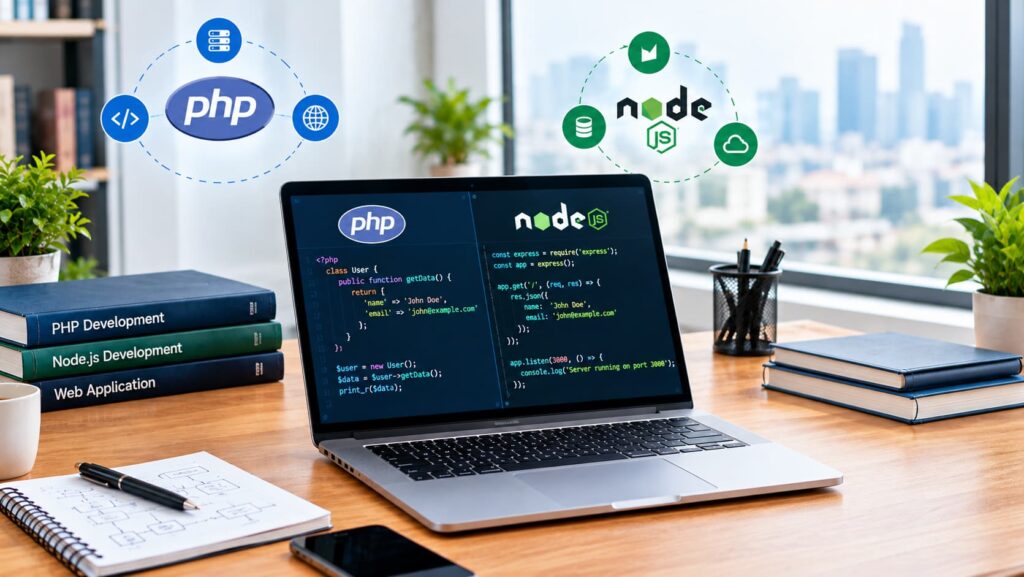
PHP vs Node.js for Business Applications: Which Backend Should You Pick?
Choosing the right backend technology is one of the most important decisions when building a business application. It affects how your software performs, how easily developers can maintain it, how much the project costs, and whether the system can support your business as it grows.
Two popular options are PHP and Node.js. Both technologies are widely used for websites, web applications, eCommerce platforms, business management systems, and custom software solutions. However, they work differently and offer different advantages.
For business owners in Bangladesh, the decision between PHP vs Node.js is not simply about choosing the newest technology. It is about finding a backend that matches your business requirements, development budget, available technical support, and long-term goals.
For example, a company planning to build a corporate website with a customer management system may have different requirements from a startup developing a real-time delivery application. PHP could be an excellent choice for the first project, while Node.js may be more suitable for the second.
In this guide, we will compare PHP and Node.js from a practical business perspective. You will learn how they work, where each technology performs best, their development costs, security considerations, scalability, and which backend is suitable for different types of business applications.
Understanding PHP and Node.js
Before comparing their performance and features, it is important to understand what PHP and Node.js actually are.
Both technologies help developers build the server-side part of an application. This is the part responsible for processing requests, communicating with databases, managing users, handling business logic, and delivering information to the frontend.
However, PHP and Node.js use different approaches to handle these responsibilities.
What Is PHP?
PHP is a widely used server-side programming language designed primarily for web development. It allows developers to create dynamic websites, web applications, content management systems, and database-driven business platforms.
PHP has been around since 1995 and has developed into a mature technology with a large ecosystem of frameworks, libraries, hosting providers, and development tools.
One of its biggest advantages is its accessibility. Businesses can find PHP developers, hosting services, and technical resources relatively easily.
PHP is also the foundation of popular platforms such as WordPress, Drupal, and many other web-based systems.
Common business applications built with PHP include:
- Corporate websites and business portals
- eCommerce websites and online marketplaces
- Customer relationship management (CRM) systems
- Enterprise resource planning (ERP) applications
- Inventory and warehouse management software
- School and educational management systems
- Booking and appointment platforms
- Custom web applications
PHP works particularly well for traditional request-response applications where users submit information, access dashboards, manage records, and interact with database-driven features.
What Is Node.js?
Node.js is a JavaScript runtime environment that allows developers to run JavaScript outside a web browser, including on a server.
It was introduced in 2009 and became popular because it allows developers to use JavaScript for both frontend and backend development.
Node.js uses an event-driven, non-blocking input/output model. This approach allows applications to handle many simultaneous operations without waiting for each operation to finish before processing another.
It is particularly useful for applications that require frequent communication between users and servers.
Common business applications built with Node.js include:
- Real-time communication platforms
- Live chat applications
- Online collaboration tools
- Food delivery and logistics platforms
- Real-time dashboards
- Streaming applications
- SaaS products
- API-driven applications
- Multi-user business platforms
Node.js is a strong option for businesses that need responsive applications with frequent data updates and real-time interactions.
PHP vs Node.js: Key Differences at a Glance
Both technologies can build professional business applications, but their technical approaches and development ecosystems are different.
Here is a quick comparison of the most important factors.
| Comparison Factor | PHP | Node.js |
| Technology type | Server-side programming language | JavaScript runtime |
| First released | 1995 | 2009 |
| Main language | PHP | JavaScript |
| Execution model | Commonly request-based | Event-driven and non-blocking I/O |
| Real-time applications | Supported | Particularly suitable |
| Database support | Extensive | Extensive |
| Development ecosystem | Mature and established | Modern and extensive |
| Popular frameworks | Laravel, Symfony | Express.js, NestJS |
| Content management | Excellent ecosystem | Requires more custom development |
| API development | Excellent | Excellent |
| Hosting availability | Very widely available | Requires a compatible runtime environment |
| Learning requirements | PHP knowledge | JavaScript and Node.js knowledge |
| Best suited for | Traditional web and business applications | Real-time and event-driven applications |
The comparison shows that neither technology is universally better. The right choice depends on what you are building and how your application will operate.
1. Performance: Which Backend Is Faster?
Performance is an important consideration when developing business applications. A slow website or application can frustrate customers, reduce productivity, and affect the overall user experience.
However, backend performance is not determined by programming language alone. Database queries, server resources, application architecture, caching, and code quality also play major roles.
PHP Performance
Modern PHP has improved significantly over the years. PHP 8 introduced several performance improvements, including the JIT compiler and other runtime optimizations.
PHP applications can deliver excellent performance when developers follow good coding practices and use suitable infrastructure.
For example, a Laravel-based business management application can handle customer records, product information, employee accounts, invoices, and reporting features efficiently.
PHP is particularly effective for applications with predictable request-response workflows.
Performance can be improved through:
- OPcache for PHP bytecode caching
- Redis for caching frequently accessed data
- Database indexing and query optimization
- Content delivery networks (CDNs)
- Efficient application architecture
- Appropriate server configurations
Node.js Performance
Node.js is designed around an event-driven, non-blocking I/O architecture.
This makes it effective when an application needs to handle multiple simultaneous network requests, database operations, and other I/O activities.
For example, an online delivery platform may need to update delivery status, receive customer requests, communicate with drivers, and display live information.
Node.js can manage these types of operations efficiently.
However, CPU-intensive tasks such as complex image processing, large calculations, and intensive data transformations may require additional workers or separate processing services.
Performance Verdict
Both technologies can deliver fast business applications.
Choose PHP when your application mainly involves database operations, user accounts, content management, and traditional business workflows.
Consider Node.js when your application handles frequent simultaneous connections, real-time communication, or event-driven operations.
2. Scalability: Which Technology Supports Business Growth?
A business application that works well with 100 users may face challenges when the number increases to 10,000 or more.
Scalability means your application can handle increasing users, transactions, and data without requiring a complete system redesign.
Scaling PHP Applications
PHP applications can scale horizontally by running multiple application instances behind a load balancer.
Businesses can also improve performance by introducing:
- Redis caching
- Database replication
- Queue-based background processing
- Cloud infrastructure
- Separate services for resource-intensive tasks
- Load balancing and optimized server configurations
Laravel also provides tools for queues, scheduled tasks, caching, and application management.
This makes PHP suitable for growing business applications, including eCommerce platforms, management systems, and customer portals.
Scaling Node.js Applications
Node.js also supports horizontal scaling and distributed application architecture.
Its asynchronous execution model can be useful when many users interact with the system simultaneously.
Developers can use multiple application instances, worker processes, message queues, and microservices to distribute workloads.
For example, a growing SaaS platform may separate user authentication, payment processing, notifications, and real-time communication into independent services.
This approach can help teams scale different parts of an application according to demand.
Scalability Verdict
Both PHP and Node.js can support large business applications.
The important factor is how the application is designed. A poorly structured Node.js application can struggle under heavy traffic, just as an inefficient PHP application can.
For most businesses, choosing a technology based on actual growth requirements is more useful than choosing one simply because it is associated with large-scale systems.
3. Security: Which Backend Is More Secure?
Security is a major concern for businesses that manage customer information, financial records, employee details, and confidential company data.
Both PHP and Node.js can be used to build secure applications. However, security depends heavily on how developers write, test, configure, and maintain the software.
PHP Security
PHP has a mature security ecosystem. Frameworks such as Laravel provide built-in features that help developers protect applications against common security threats.
Laravel includes:
- CSRF protection for web forms.
- Password hashing for user authentication.
- Protection against SQL injection through parameterized database queries and its query builder.
- Input validation and request handling.
- Authentication and authorization tools.
- Secure session management.
These features make PHP a practical choice for applications that manage customer accounts, business records, and online transactions.
Node.js Security
Node.js also offers several security tools and development practices.
Developers can use established libraries and frameworks to implement authentication, input validation, access control, and secure API communication.
Important security practices include:
- Using trusted and regularly updated npm packages.
- Validating incoming API requests.
- Protecting authentication tokens and sessions.
- Implementing rate limiting.
- Using HTTPS and secure communication.
- Monitoring third-party dependencies.
- Applying proper access permissions.
Because Node.js projects often depend on external packages, developers must pay attention to dependency management and security updates.
Security Verdict
Neither PHP nor Node.js is automatically more secure.
For a business application, choose an experienced development team that follows secure coding standards, performs regular updates, implements proper authentication, and tests the application before deployment.
4. Development Cost: Which Backend Is More Affordable?
Development cost is one of the most important factors for startups and small businesses in Bangladesh.
The total cost of a software project depends on its features, complexity, developer experience, infrastructure, maintenance requirements, and development timeline.
However, the technology you select can influence the overall project budget.
PHP Development Costs
PHP is a cost-effective option for many traditional business applications.
There are several reasons for this:
- A large number of PHP developers are available.
- Many hosting providers support PHP.
- Open-source frameworks reduce development effort.
- Laravel offers reusable tools for common business features.
- WordPress can reduce development time for suitable content-driven projects.
For example, a small business that needs a corporate website, service pages, contact forms, and a basic customer management system may find PHP a practical solution.
Node.js Development Costs
Node.js can also be cost-effective, particularly for businesses that already have JavaScript developers or need a shared JavaScript development environment.
It can reduce the need to maintain separate programming languages across frontend and backend development.
However, applications with complex real-time features, distributed services, or specialized infrastructure may require additional development and operational planning.
Cost Verdict
PHP may offer a practical budget advantage for traditional websites and business management applications.
Node.js may provide better development efficiency for JavaScript-based products and real-time platforms.
Businesses should compare the complete project cost rather than focusing only on the initial development price.
5. Development Speed and Developer Availability
A technology is only useful when a business can find skilled developers to build, maintain, and improve its application.
Developer availability is particularly important in Bangladesh, where businesses often work with local software development companies or independent development teams.
PHP Development Ecosystem
PHP has been used in web development for decades. It has a large developer community, extensive documentation, and many established frameworks.
Laravel is especially popular for custom web application development.
Its built-in tools help developers create:
- User registration and login systems
- Admin dashboards
- Customer management features
- Payment integrations
- Database-driven applications
- Reporting systems
- REST APIs
This established ecosystem can reduce development time for common business requirements.
Node.js Development Ecosystem
Node.js has a strong developer ecosystem built around JavaScript and npm.
Developers can use JavaScript across the frontend and backend, making it easier for some teams to share code and development knowledge.
Popular frameworks include Express.js, NestJS, and Fastify.
Node.js is particularly useful for API-driven applications, modern SaaS products, and systems that require real-time communication.
Development Speed Verdict
PHP with Laravel is an excellent choice when the project involves conventional business workflows and database-driven features.
Node.js can be more convenient when the project requires a JavaScript-based architecture across multiple application layers.
The experience of the development team matters more than the popularity of a framework.
6. Database Support and Integration
Every business application needs a reliable way to store, retrieve, and manage information.
This may include customer details, orders, payments, employee records, inventory, product information, and business reports.
Both PHP and Node.js support popular database technologies.
PHP Database Support
PHP works with several database systems, including:
- MySQL
- MariaDB
- PostgreSQL
- SQLite
- Microsoft SQL Server
Laravel makes database management easier through its ORM, query builder, migrations, and database configuration tools.
For example, a retail business can use a PHP-based application to manage products, stock levels, customer information, invoices, and sales records.
Node.js Database Support
Node.js also supports a wide range of databases, including:
- MySQL
- PostgreSQL
- MongoDB
- Redis
- SQLite
- Microsoft SQL Server
Developers can use libraries and ORMs such as Prisma, Sequelize, and Mongoose, depending on the selected database.
Node.js is suitable for applications that combine structured business records with real-time data processing.
Database Verdict
Both technologies provide excellent database support.
The best database depends on the structure of your information, reporting requirements, data relationships, and application architecture.
For many Bangladeshi business applications, MySQL or PostgreSQL can be reliable choices with either backend.
7. Popular Frameworks: Laravel vs. Express.js and NestJS
Frameworks provide reusable tools and structures that make application development easier.
Choosing the right framework can improve code quality, development speed, security, and long-term maintenance.
Laravel (PHP)
A structured framework for database-driven web applications and business software.
Node.js ecosystem
A flexible JavaScript backend ecosystem for APIs and event-driven applications.
Laravel
Laravel is one of the most popular PHP frameworks.
It offers a structured development environment and tools for building custom business applications.
Its major features include:
- Authentication and authorization.
- Database migrations and ORM.
- Background job queues.
- Caching.
- API development.
- Application scheduling.
- Validation and security features.
Laravel is particularly suitable for ERP, CRM, inventory management, booking systems, and custom administrative platforms.
Express.js
Express.js is a lightweight framework for Node.js.
It provides a flexible foundation for creating APIs and web applications.
Developers can select the libraries and architecture that best match their project requirements.
NestJS
NestJS is a structured framework for developing scalable server-side applications.
It supports modular architecture, dependency injection, and TypeScript.
NestJS can be useful for enterprise applications, complex APIs, and larger development teams that need consistent project organization.
Framework Verdict
For structured business applications, Laravel is a strong choice.
For JavaScript-based backend development, Express.js offers flexibility, while NestJS provides a more organized structure for complex projects.
8. Which Backend Is Better for Different Business Applications?
The most effective way to choose between PHP and Node.js is to examine your actual business requirements.
Here are some practical examples.
| Business Application | Recommended Backend | Reason |
| Corporate website | PHP | Excellent traditional web ecosystem |
| eCommerce website | PHP or Node.js | Both support online stores. |
| CRM software | PHP | Laravel supports structured workflows. |
| ERP software | PHP or Node.js | Depends on system architecture |
| Inventory management | PHP | Suitable for database-driven operations |
| Live chat application | Node.js | Strong real-time capabilities |
| Food delivery platform | Node.js or PHP | Depends on live tracking requirements. |
| SaaS application | Both | Depends on product architecture |
| Real-time dashboard | Node.js | Suitable for frequent updates |
| School management system | PHP | Effective for traditional workflows |
| Booking platform | Both | Depends on integrations and live availability |
| REST API | Both | Both provide strong API development options. |
When Should You Choose PHP?
PHP is worth considering when:
- You need a corporate website or business portal.
- Your application primarily manages database records.
- You are building a CRM, ERP, or inventory system.
- You need a WordPress-based website.
- Your project has a limited development budget.
- You want access to a mature web development ecosystem.
- You need a system that can be maintained by different PHP development teams.
When Should You Choose Node.js?
Node.js is worth considering when:
- Your application requires real-time communication.
- You are developing a live collaboration platform.
- You need frequent data updates across multiple users.
- Your product uses JavaScript across the frontend and backend.
- You are building a modern API-driven SaaS platform.
- Your application processes many simultaneous I/O operations.
- You need an event-driven backend architecture.
9. Hosting and Deployment: What Should Businesses Consider?
Hosting is another important factor when selecting a backend technology.
Your application needs a reliable server environment to operate properly, handle customer requests, and store business information.
PHP Hosting
PHP is supported by a wide range of hosting providers.
Businesses can deploy PHP applications using:
- Shared hosting
- VPS hosting
- Dedicated servers
- Cloud hosting
- Managed application hosting
This flexibility makes PHP convenient for startups and businesses with different budgets.
Node.js Hosting
Node.js applications require an environment that supports the Node.js runtime.
Businesses can deploy them using:
- VPS hosting
- Cloud servers
- Container-based infrastructure
- Dedicated servers
- Managed Node.js hosting platforms
Node.js applications may also require additional configuration for background processes, WebSocket connections, and application monitoring.
Hosting Verdict
PHP generally offers more straightforward hosting options, especially for smaller websites and traditional business applications.
Node.js offers flexible deployment options for modern applications but may require more server configuration.
The right hosting solution should match your expected traffic, application architecture, security requirements, and available budget.
10. Long-Term Maintenance and Technical Support
Building an application is only the beginning. Every business needs ongoing maintenance to keep its software reliable and secure.
Over time, your business may introduce new services, add employees, expand product categories, integrate payment systems, or serve more customers.
Your backend should support these changes without creating unnecessary technical problems.
Maintaining PHP Applications
PHP has a mature ecosystem with extensive documentation and established development practices.
Laravel applications can be maintained through:
- Regular framework updates
- Database optimization
- Security patches
- Code refactoring
- Performance monitoring
- Automated testing
- Server maintenance
Businesses can also find developers familiar with existing PHP projects, which can make future maintenance easier.
Maintaining Node.js Applications
Node.js applications also require regular updates and maintenance.
Important responsibilities include:
- Updating Node.js versions.
- Managing npm dependencies.
- Monitoring application performance.
- Reviewing security vulnerabilities.
- Managing background processes.
- Testing APIs and integrations.
- Monitoring server resources.
A well-organized Node.js project can remain maintainable for many years.
Maintenance Verdict
Both technologies can support long-term business operations.
Before selecting a development partner, ask how the company handles software updates, bug fixes, documentation, backups, security monitoring, and future feature development.
How to Choose Between PHP and Node.js for Your Business
If you are still unsure about PHP vs Node.js, start with your business requirements rather than technical trends.
Use the following steps before approving a software development project.
Step 1: Define your application requirements.
Write down what the application needs to do. Identify its main features, user roles, database requirements, and integrations.
Step 2: Identify real-time requirements
Determine whether users need instant communication, live notifications, location tracking, or continuously updated dashboards.
Step 3: Set your development budget.
Consider initial development, hosting, maintenance, future upgrades, and technical support.
Step 4: Evaluate the development team
Ask about the team’s experience with PHP, Laravel, Node.js, Express.js, or NestJS. Review previous projects and technical capabilities.
Step 5: Consider future expansion.
Think about how the application may change over the next three to five years. Choose an architecture that can support your expected business growth.
Step 6: Discuss security and maintenance
Confirm that the development partner has a clear plan for backups, security updates, testing, and ongoing support.
A little planning at this stage can prevent expensive technical changes later.
Can You Use PHP and Node.js Together?
Yes. Businesses do not always need to choose only one backend technology.
PHP and Node.js can work together in a single application when the architecture and business requirements justify using both.
For example, an eCommerce company might use Laravel to manage:
- Products and categories
- Customer accounts
- Orders and payments
- Inventory management
- Administrative operations
At the same time, Node.js could manage:
- Live customer chat
- Real-time order notifications
- Instant delivery updates
- WebSocket communication
Both systems can communicate through APIs or messaging infrastructure.
However, using two backend technologies increases development complexity, infrastructure requirements, and maintenance responsibilities.
For most small and medium-sized businesses, starting with one suitable backend is often the more practical approach.
Consider a hybrid architecture only when there is a clear technical or business reason.
Common Mistakes to Avoid When Selecting a Backend
Choosing a backend based on popularity alone can create problems for your business.
Avoid these common mistakes:
1. Choosing technology only because it is trending
A popular technology is not automatically the best solution for your application. Evaluate your actual requirements first.
2. Ignoring the development budget
Do not calculate only the initial development cost. Consider hosting, maintenance, upgrades, and long-term technical support.
3. Overlooking security
Customer information, payment records, and internal business data need proper protection from the beginning.
4. Building unnecessary complexity
A small business website does not always need a complex microservices architecture. Use an approach that matches the actual project.
5. Ignoring developer availability
Make sure qualified developers can maintain and improve your application in the future.
6. Focusing only on performance benchmarks
Real application performance depends on database design, caching, infrastructure, code quality, and optimization.
Final Verdict: PHP vs Node.js – Which Backend Should You Pick?
Both PHP and Node.js are capable backend technologies for modern business applications. The better choice depends on the type of software you want to develop, your technical requirements, and your long-term business plans.
PHP with Laravel is an excellent option for corporate websites, eCommerce platforms, CRM systems, ERP applications, inventory management software, and traditional database-driven business solutions.
Node.js is particularly suitable for real-time applications, live communication platforms, event-driven systems, API-based products, and modern SaaS applications that require frequent interaction between users and servers.
For Bangladeshi businesses, PHP can be a practical starting point when the primary goal is to build reliable business software within a reasonable budget. Node.js becomes an attractive option when real-time capabilities and JavaScript-based development are important.
Our recommendation: Do not select a backend simply because another company uses it. Select the technology that solves your business problems, fits your budget, and gives your application room to grow.
At Creative Tech Park, we believe successful software development starts with understanding the business, not just choosing a programming language.
Frequently Asked Questions (FAQs)
1. Is PHP better than Node.js for business applications?
PHP is often a practical choice for traditional business applications, including CRM, ERP, eCommerce, and inventory management systems. Node.js is particularly useful for real-time applications and event-driven systems. Neither is universally better.
2. Is Node.js faster than PHP?
Node.js can handle concurrent I/O operations efficiently because of its non-blocking architecture. Modern PHP also delivers strong performance. Actual application speed depends on code quality, database optimization, server resources, and application design.
3. Which is cheaper to develop, PHP or Node.js?
PHP can be more affordable for many traditional web applications because of its mature ecosystem and broad hosting support. However, Node.js may be cost-effective for teams already using JavaScript across their development projects.
4. Is PHP still relevant for modern web development?
Yes. PHP remains a widely used web development technology. Modern versions, frameworks such as Laravel, and its extensive hosting ecosystem make it suitable for many professional websites and business applications.
5. Can Node.js handle large-scale applications?
Yes. Node.js supports horizontal scaling, distributed architectures, background processing, and event-driven development. It can be used for large applications when properly designed and maintained.
6. Which is better for eCommerce development?
Both PHP and Node.js can support eCommerce applications. PHP offers established solutions and frameworks, while Node.js can be useful for custom platforms with real-time features and specialized APIs.
7. Which backend is better for a startup in Bangladesh?
The decision depends on the startup’s product, budget, development team, and future requirements. PHP with Laravel is a strong option for many business management and eCommerce projects. Node.js is worth considering for real-time products and JavaScript-based platforms.
8. Can I migrate from PHP to Node.js in the future?
Yes. A PHP application can be migrated to Node.js, but the process requires planning, database compatibility checks, API development, testing, and potentially rewriting application features. A gradual migration may be possible depending on the existing architecture.
9. Is Laravel better than Express.js?
Laravel provides a more complete framework with many built-in tools for common business requirements. Express.js is lightweight and flexible, allowing developers to select their preferred libraries and architecture. The right choice depends on the project.
10. Should I use PHP or Node.js for a custom business management system?
PHP with Laravel is a strong option for systems involving employee management, customer records, inventory, invoices, reporting, and administrative workflows. Node.js is also suitable, particularly when the system requires substantial real-time functionality.
Build the Right Business Application with Creative Tech Park
Choosing the right backend is an important step, but successful software development requires much more than selecting PHP or Node.js.
Your business needs a development partner who understands your goals, plans the application architecture, builds reliable features, and provides technical support as your company grows.
Creative Tech Park is a Dhaka-based web design, software development, and IT services agency operating since 2012.
With 26 in-house team members, 5,000+ clients, and 7,000+ completed projects, Creative Tech Park works with businesses looking for professional digital solutions.
Whether you need a corporate website, custom web application, eCommerce platform, CRM, ERP, or other business software, selecting the right development approach can help you build a stronger digital foundation.
Ready to discuss your next software project?
Visit Creative Tech Park to explore professional web design and software development services and discuss the right technology for your business.
- Backend Development
- Backend Technologies
- Business Applications
- Custom Software Development
- Express.js
- Laravel Development
- Node.js Development
- PHP Development
- PHP vs Node.js
- Software Development Bangladesh
- Web Application Development

Written by
Abdullah Al Masum
Part of the Creative Tech Park team in Dhaka, Bangladesh, building websites, apps and business software since 2012.